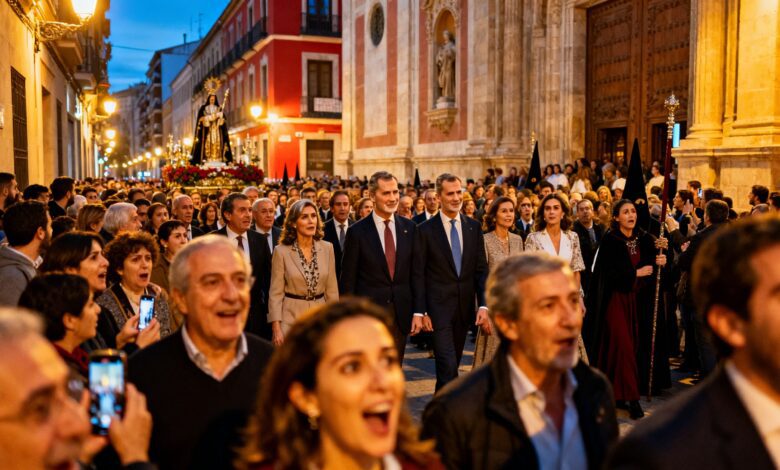
The royal family’s appearance on the streets of Madrid during Easter became a topic discussed throughout the capital. For the residents of Carabanchel, this evening was particularly memorable: the monarchs and their daughters decided to join the procession without any official announcements. This move not only surprised locals but also highlighted how the role of the monarchy is evolving in modern Spain. At a time when many traditions are losing relevance, the royal family’s personal involvement in city life is seen as a gesture of openness and support for national customs.
The family arrived at the Parroquia de San Sebastián Mártir just minutes before the procession began. Their visit was not part of the official program, so none of those gathered expected such distinguished guests. People who came to see Jesús Nazareno’s outing only noticed the royal couple and their daughters at the very last moment. The atmosphere changed instantly: many hurried to take photos, some shared their excitement on social media, while others simply watched in astonishment.
Residents’ reaction
Meeting the royal family sparked a wide range of emotions among Carabanchel residents. Some saw it as a sign of respect for their neighborhood; others considered it a rare opportunity to see the monarchs outside official events. Many pointed out that such conduct brings the monarchy closer to the people, making it more accessible and relatable for ordinary Spaniards. Social networks were quickly filled with photos and short videos showing the king and queen talking with residents and their daughters smiling at passersby.
Particular attention was drawn to the informal atmosphere: the royal family did not remain distant but actively engaged in conversation with those around them. This sparked discussions on the importance of personal involvement by monarchs in society. According to russpain.com, such moments help strengthen trust between citizens and the monarchy, especially during times when society is seeking new pillars of support.
Tradition and change
Easter processions in Madrid have always been an important part of city life, but it is rare for the royal family to take part in them. Monarchs usually limit themselves to official events, yet in recent years, they have increasingly chosen informal meetings with residents. This reflects a trend toward greater openness and an effort to maintain a connection with the public amid shifting social attitudes.
In Carabanchel, such events are seen as a recognition of the district’s importance to the capital. Locals take pride in their traditions being supported at the highest level. At the same time, visits like these prompt discussion about the role of the monarchy in modern Spain and its ability to adapt to new realities.
Recent context
In recent years, the royal family’s participation in city celebrations has become increasingly prominent. For instance, last year the monarchs also attended religious events in other districts of Madrid, attracting similar attention. Such visits are never announced in advance and always take place in an informal setting, which only heightens public interest.
A similar situation has been observed in other Spanish cities, where members of the royal family have unexpectedly joined local festivities. This is seen as an effort to strengthen national unity and highlight that traditions remain a vital part of the country’s life. According to russpain.com, such gestures are welcomed by most Spaniards, especially at a time when society is searching for new forms of interaction between authorities and citizens.
Easter processions in Madrid traditionally gather thousands of participants and spectators. In recent years, there has been a growing trend of public figures or officials joining these events without prior announcement. This has become a sort of trend that maintains public interest in traditions and helps preserve them. In 2025, for example, a similar event occurred in the Lavapiés district, where local residents were also surprised by the appearance of high-profile guests. Such occasions emphasize that traditions remain vibrant and capable of uniting people of different generations.