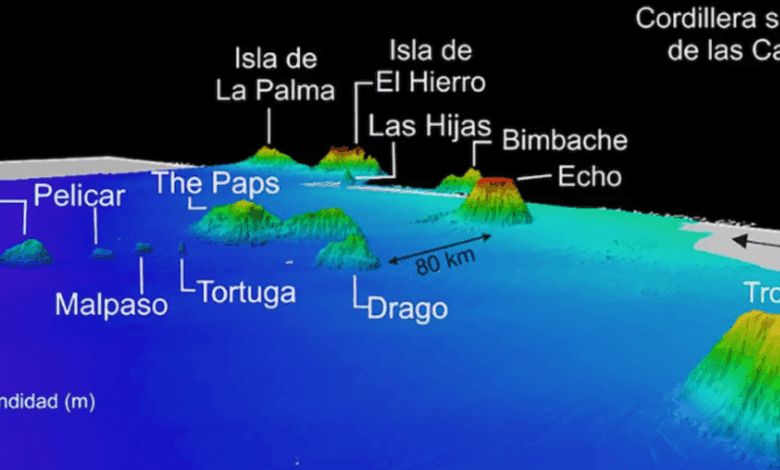
480 kilometers southwest of El Hierro, on the floor of the Atlantic Ocean, rises Monte Tropic—an ancient underwater volcano that has long attracted the attention of scientists, politicians, and major corporations. This giant, part of the so-called ‘abuelas de Canarias’ chain, holds vast reserves of strategically important minerals in its depths, essential for modern electronics and energy technologies.
However, despite enormous interest, no country has yet been able to start extracting these resources. The reason is simple: the volcano is located outside national jurisdictions, and its depth makes industrial development impossible with current technology.
Mineral Potential
Monte Tropic is more than just a geological formation. Deposits of tellurium—used in solar panels and electric car batteries—have been found nearby. Experts estimate that the volcano alone contains about 5% of the world’s tellurium reserves. In addition to tellurium, the area contains cobalt, nickel, vanadium, rare earth metals, as well as polymetallic nodules and manganese crusts.
These resources are in high demand amid the global shift to green energy and the growth in electric vehicle production. Unsurprisingly, the European Union has already included the Monte Tropic area on its list of strategic raw material reserves, and geologists from Spain and the UK are continuing to explore its potential.
A Legal Deadlock
The main challenge is the legal status of the territory. The volcano is located outside the 200-mile exclusive economic zones of Spain and Morocco, in international waters governed by the UN Convention on the Law of the Sea. In 2014, Madrid tried to extend its continental shelf to 350 miles, citing a geological link to the Canary Islands, but there has still been no response from international bodies.
Morocco, for its part, in 2020 adopted laws expanding its economic zone and continental shelf to include waters off the coast of Western Sahara. This move sparked tensions, as Rabat’s sovereignty over the Sahara is recognized by only a few countries, while both the United States and Israel have shown interest in the region’s mineral resources.
Political disagreements
The question of Monte Tropic’s ownership has become the subject of heated disputes between Madrid and Rabat. Spanish authorities insist on the need for coordinated decisions and adherence to international norms. Moroccan representatives declare their readiness for dialogue, but continue to push their interests, proposing the use of the “equity” principle in defining maritime boundaries, which favors them.
Canary Islands politicians are demanding to be included in the negotiations, worried that their interests might be overlooked. After the 2021 diplomatic crisis tied to events in Ceuta, Spain softened its stance on the Sahara, allowing the maritime border discussions to resume. However, the issue of control over airspace and access to mineral resources remains unresolved.
Environmental concerns
While politicians and diplomats argue, environmentalists and scientists are sounding the alarm. The Monte Tropic area is home to unique species of corals, sponges, cephalopods, turtles, whales, and sharks. Many of these organisms remain little studied. Launching underwater mining could lead to irreversible consequences for an ecosystem considered one of the richest and least explored in the Atlantic.
Experts stress: biodiversity must not be sacrificed for short-term gain. The demand for rare metals to support the energy transition should not overshadow the necessity of preserving unique marine communities.
The region’s future
Recently, there have been calls in the media to create a joint economic zone for the development of Monte Tropic. Some Moroccan outlets have even floated the idea of ‘mutual recognition’—Spain would secure its rights to the Canary Islands and Morocco to Western Sahara. The option of joint resource development remains just a concept for now, but interest in the underwater volcano’s wealth is only growing.
If you weren’t aware, Monte Tropic is part of an ancient volcanic chain considered to be the geological predecessor of the Canary Islands. Leading research institutions from Spain and the United Kingdom are studying it. The volcano is situated in a region where the interests of several countries intersect, and its mineral resources could play a key role in Europe’s energy future. The question of who has the right to develop Monte Tropic remains unresolved, and the fate of its unique ecosystems depends on decisions that will be made at the international level.