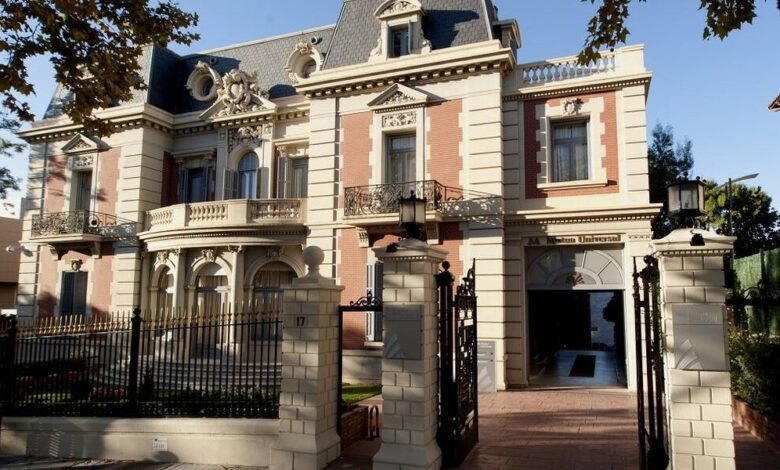
In the northern part of Barcelona, on Tibidabo Avenue, beneath the façade of an elegant mansion, hides one of the most unusual monuments of 20th-century history. Here, in the basement of the building, now housing the Mutua Universal office, lies a bunker considered the best-preserved of its kind in the city.
The mansion was built in the early 20th century, designed by architect Enric Sagnier for pharmacist Salvador Andreu. Initially, the house symbolized prosperity and technological progress, but with the outbreak of the Civil War, its fate changed dramatically. In 1937, as Barcelona endured air raids, the building was requisitioned by the Republican authorities and handed over to the Soviet diplomatic mission. It was then that a reinforced bunker of over 50 square meters was constructed under the mansion.
The shelter’s walls are made of reinforced concrete 40 centimeters thick, and the entrance is protected by double iron doors with an internal locking system. Inside, there are dedicated workspaces, sanitary areas, and an autonomous electric generator, enabling independence from external communications even during complete isolation. The bunker has also preserved its kitchen and ventilation system, which supplied fresh air during bombings.
During the war years, the Soviet mission led by Vladimir Antonov-Ovseenko transformed this place not only into a refuge but also into a center for coordinating military and humanitarian operations. From here, weapons and aid were supplied to Republican forces, and key decisions were made that influenced the course of events in Spain. It was from this building that the operation to arrest the POUM leader, Andreu Nin, was organized in the summer of 1937.
After the war, Andreu’s family regained the mansion, which remained almost exactly as the Soviet diplomats had left it. In the following decades, including the 1970s, official receptions for representatives of the Francoist government were held here, but only a few knew about the existence of the bunker.
Today, the Tibidabo mansion is protected as a monument of architecture and history. Its facade and well-kept garden reveal nothing of the unique underground site, which remains largely unchanged. The bunker is closed to visitors, but from time to time Mutua Universal publishes photos of its interiors. Inside, original features are still visible: old mechanisms, plaques, and a faded Soviet flag, which, according to legend, was a gift from Antonov-Ovseenko before his return to Moscow.
Unlike most Civil War shelters, which have either been destroyed or are in a state of disrepair, this bunker stands out for its integrity and authenticity. It has become a kind of time capsule, serving as a reminder that international conflicts and diplomatic intrigues have left their mark not only on the streets, but also in the underground of Barcelona.
Today, this site remains little-known even among locals. Its preservation can be attributed to the fact that the bunker entrance is disguised as a decorative tower of a mansion, and access is strictly limited. Thanks to this, the historical monument has avoided destruction and still preserves the atmosphere of those turbulent years in Spanish history.