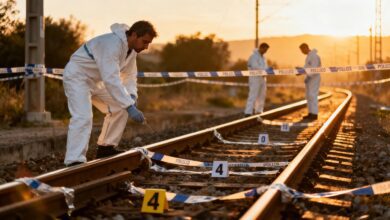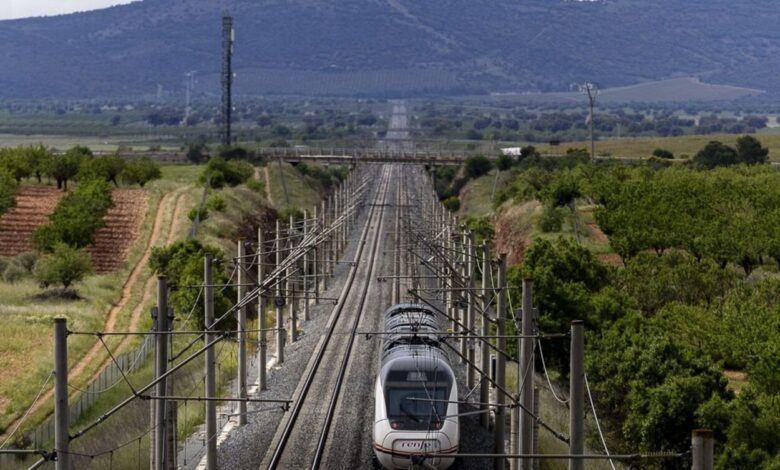
Thousands of passengers rushing from Andalusia to other parts of Spain were greeted with an unpleasant surprise this morning. Unknown attackers cut a cable on the stretch between Guadajoz and Córdoba stations, causing a failure of the entire signaling system on the high-speed rail lines. As a result, trains that usually race down these tracks at dizzying speeds suddenly found themselves trapped by delays and chaos.
The problems began before dawn. Around 12:30 a.m., a cable theft was detected on the main rail line connecting Sevilla and Córdoba. These aren’t just wires—they’re a key component of the rail traffic control system that ensures safety and precise schedules throughout the line. Without this equipment, trains have to move much more slowly, and drivers must receive permission to proceed through each section manually.
Delays and cancellations
As a result of the incident, all long-distance and regional trains passing through this section faced significant delays. The average delay was about 35 minutes, but for some routes, the situation was even worse. The French operator Ouigo was forced to completely cancel the morning train from Madrid to Sevilla, which was scheduled to depart at 8:42. For many passengers, this was a real test of patience.
Railway workers tried to minimize the impact, but technical limitations prevented them from quickly restoring the usual pace of operations. Trains ran on only one of two tracks, and in certain sections, temporary timetables were introduced, which led to even more delays. On social media, passengers shared photos of overcrowded carriages and complained about a lack of information.
Technical Failure
The cause of the transport disruption was a breakdown of the Linienzugbeeinflussung (LZB) system—a German technology that has handled automatic train control on Spanish high-speed lines since 1992. Without it, train drivers are forced to rely on visual signals and verbal instructions from dispatchers. This not only reduces speed but also increases the risk of mistakes.
The problem was especially acute on the stretch between Córdoba and the Málaga junction, where traffic became congested in both directions. Trains proceeded under special permission to pass prohibitive signals (BSL), and in some areas, a practice known as ‘banalization’—temporarily switching both directions onto one track—was used. This prevented a complete halt in service but did not avoid widespread delays.
Response and Consequences
The railway company promptly reported the incident and promised to resolve the consequences as quickly as possible. However, restoring normal operations will take time: the damaged cable must not only be replaced, but the entire signaling system must be diagnosed. While specialists are working on site, passengers can only wait and hope for the schedule to return to normal soon.
The situation has sparked a wave of indignation among rail users. Many are asking why such critical infrastructure remains vulnerable to theft and why similar incidents occur with alarming regularity. In fact, cable theft is not uncommon in Spain: such incidents have previously caused transport disruptions, but effects on this scale are rare.
Passengers waiting
While railway workers are dealing with the aftermath, thousands are forced to adjust their plans. Some missed important meetings, others failed to make their connections, and some were simply stuck in carriages without any clear idea of when the train would finally depart. On social media, people are discussing not only the theft itself, but also the response from transport companies, which many believe do not always inform passengers promptly about such events.
However, despite all the inconveniences, train service was not completely suspended. Thanks to temporary measures and the coordinated efforts of the staff, the railway continues to operate, though with noticeable disruptions. Nevertheless, this incident once again raises concerns about infrastructure security and the need for stricter oversight of strategic facilities.