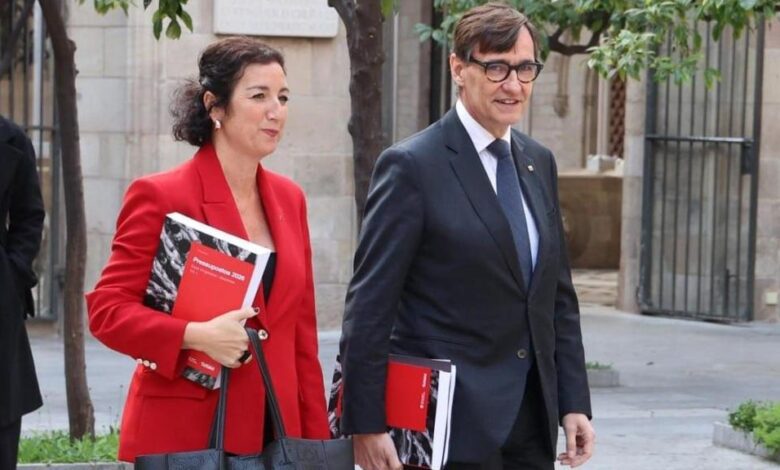
The situation surrounding Catalonia’s 2026 budget has become one of the most pressing topics across Spain. The breakdown in negotiations between the Socialists and ERC (Esquerra Republicana de Catalunya) not only threatens regional stability but could also trigger early elections, potentially reshaping the country’s political landscape. For Spaniards, this means new economic risks and possible changes in relations between Madrid and Barcelona.
Negotiations reach an impasse
Despite personal involvement from Pedro Sánchez and several ministers, attempts to secure ERC’s support for the budget ended in failure. The main sticking point was granting Catalonia full control over income tax (IRPF) collection, along with disputes over infrastructure projects. According to Ale Espanol, the Socialists counted on a compromise, but ERC remained steadfast. As a result, Illa (Salvador Illa) was left with support only from the Comunes party, which is clearly insufficient for the budget to pass in the Catalan parliament.
In Madrid, there are concerns that a budget failure in Catalonia could also destabilize the central government. Support from Catalan parties has been crucial for nationwide decision-making in recent years. Now, if Illa calls early elections, this could lead to a prolonged political crisis and complicate the work of Spain’s parliament.
Possible consequences for the entire country
If new elections are called in Catalonia, the country’s political climate could become even more tense. Spain is already experiencing a series of regional elections: after voting in Extremadura, Aragon, and Castile and León, elections are scheduled in Andalusia in June. Should Catalonia join this list, uncertainty in the Congress of Deputies will increase and Pedro Sánchez’s plans to serve out his full term could be thrown into question.
Within Catalonia itself, ERC’s position appears relatively stable, despite pressure from new political forces such as the far-right bloc Aliança Catalana. According to Ale Espanol, Socialists fear that in the event of early elections, both ERC and Junts would be forced to distance themselves from Sánchez’s government to avoid losing voter support. This virtually rules out the possibility of passing a state budget anytime soon.
Key players and new demands
Deputy Prime Minister María Jesús Montero also played an active role in the negotiations, and, according to media reports, is expected to leave the government as early as the beginning of April. This further limits the window for reaching a compromise. ERC representative Isaac Albert insists on changing the legislation so that Catalonia and other autonomous communities can collect IRPF independently. However, the Socialists continue to block this initiative, arguing that it is impossible to revise the law on regional financing.
With negotiations at an impasse and the budget vote deadline fast approaching, the likelihood of early elections in Catalonia is rising. This could result in new alliances and unexpected outcomes, as has already occurred in other regions. Recently, for example, there was debate in Spain about how new political forces such as Vox have shifted the balance of power in smaller towns — for more details, see the report on Abascal’s regional strategy.
Context and recent developments
In recent years, Spain has faced situations where regional disagreements have affected the work of central authorities. In 2023, a similar crisis in Catalonia led to prolonged negotiations and delayed budget approval. In 2024, early elections in Andalusia were also triggered by the failure of coalition agreements. Incidents like these show that political instability in one region quickly impacts the entire country, affecting the economy, social sphere, and Spain’s international image.