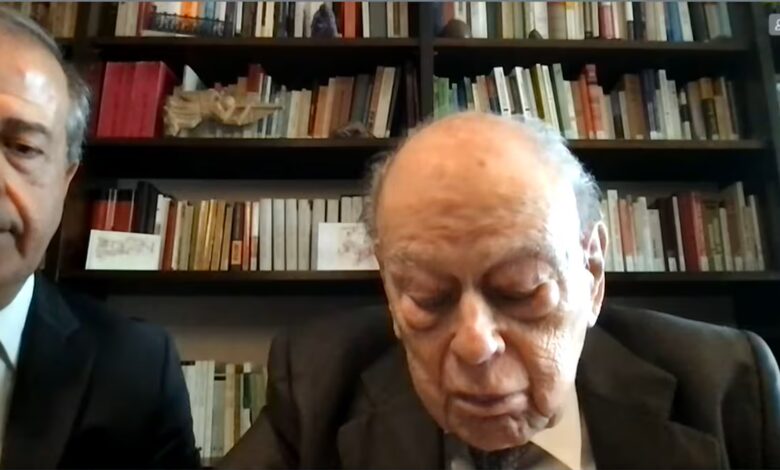
At the start of the week, 95-year-old Jordi Pujol appeared via video link from his apartment in Barcelona. His participation in the hearing at the Audiencia Nacional became one of the most talked-about moments in the case concerning the origins of his family’s wealth. Despite doctors’ reports stating that the former president of Catalonia was unable to adequately defend himself, the court decided not to halt the proceedings. This sparked a strong reaction among Catalan independence supporters: Junts representatives and parliamentary speaker Josep Rull sharply criticized the court’s decision.
Pujol was allowed not to attend all hearings — he is required to appear only for his own testimony, which is scheduled for spring 2026. The judges reserved the right to reassess his health closer to that date. For now, the proceedings continue despite protests from his family and politicians.
Age is not a reason for release
Cases of defendants over 90 years old appearing in court are rare in Spain, but not unheard of. Pujol is not the oldest accused person in the country’s history. Last year in Cuenca, a 97-year-old man was tried for attempting to kill his wife with a hammer. Despite his advanced age, the court sentenced him to 11 years and 3 months in prison, refusing to impose additional supervision upon release — by that time, the man would have been 108 years old.
Spanish law does not provide for automatic exemption from criminal liability upon reaching a certain age. Experts explain that age is only taken into account when serving a sentence: inmates over the age of 70 may qualify for earlier parole. As of mid-2025, there were three men over 90 years old in Spanish prisons, as well as dozens of inmates aged 71 to 90.
Aging Defendants: Statistics and Exceptions
According to the National Institute of Statistics (INE), the number of people convicted in Spain over the age of 70 has nearly quadrupled in the past ten years: from 1,270 in 2013 to 4,952 in 2024. However, the statistics do not break down people over 70 into smaller age groups.
The only exception that allows for the termination of criminal prosecution due to age is recognized dementia. If a person is unable to defend themselves due to severe cognitive impairment, the court may dismiss the case. This is precisely what Pujol’s defense team tried to rely on, presenting a report on his ‘irreversible and progressive’ memory decline and a diagnosis of mixed neurocognitive disorder, which includes elements of Alzheimer’s disease and vascular dementia.
However, the court did not find these arguments sufficient. Unlike Pujol’s wife, Marta Ferrusola, who was exempted from liability due to Alzheimer’s disease, the former president himself remains among the accused. His son, Oriol Pujol, has openly expressed the family’s bewilderment at the court’s decision, noting that even a remote video testimony seems strange to them.
Parallels with Other High-Profile Cases
Pujol’s story brings to mind other well-known figures who found themselves in the dock at an advanced age. One of the most notable examples is Fèlix Millet, former head of the Palau de la Música Catalana. In 2017, at the age of 81, he was tried for embezzling funds from the institution. Despite his poor health, Millet was found guilty and sent to prison, where he spent more than two years before being released on humanitarian grounds due to a terminal illness. He died without ever returning most of the stolen millions.
In both cases—Pujol and Millet—age and illness did not prevent the courts from sentencing them. The proceedings dragged on for years, marked by numerous defense motions and delays, but ultimately resulted in real prison terms for the accused.
Family Drama and Personal Stance
The court’s decision came as a shock to Puchol’s family. On the first day of the hearings, all seven of his children watched as their father joined the session from home with the help of his lawyer. Puchol himself acknowledged that his health is failing, but stated he is ready to cooperate with the court and defend his reputation. According to his relatives, he intends to appear in court in person to prove his innocence and refute the corruption charges.
However, his relatives believe that Puchol’s willingness to take part in the trial should not be the sole reason for continuing the case. They point to medical reports and insist the court should have taken them into account.