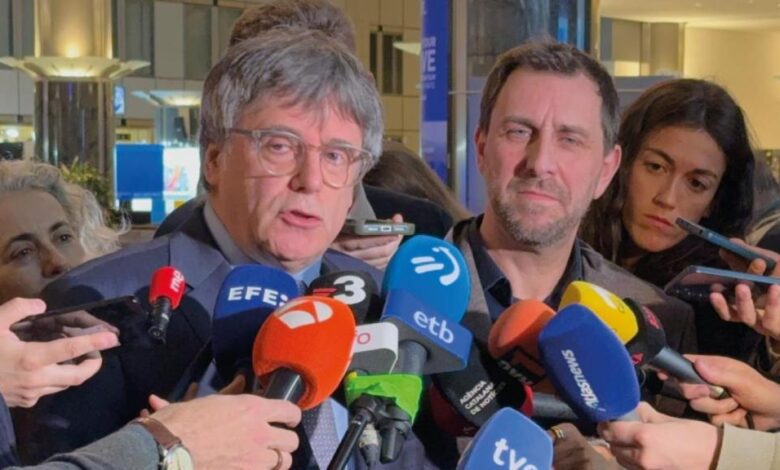
The European Court’s ruling on Carles Puigdemont’s immunity delivered an unexpected twist to Spain’s entire political landscape. For the first time in a long while, there is a real prospect for shifting the balance between Madrid and Barcelona. For many Spaniards, this is more than just a legal dispute—it’s about the future of relations between the central government and the autonomous regions.
The EU Court found that stripping Puigdemont, as well as Toni Comín and Clara Ponsatí, of their parliamentary immunity was carried out in violation of the principle of impartiality. The decision notes that the rapporteur on the case, Angel Dzhambazki, failed to meet neutrality requirements, as he had participated in public campaigns advocating for Puigdemont’s arrest. This became the key factor in overturning the decisions of the European Parliament and the previous EU court verdict.
Impact on the amnesty
The five judges who signed this ruling will also take part in reviewing the issue of amnesty for those involved in the Catalan process. Political circles in Catalonia view this as a clear signal: if the judges maintain their current stance, the chances of the amnesty law being approved look much stronger. The Junts party believes this outcome could reopen dialogue with Pedro Sánchez’s government.
In November 2025, Junts announced the termination of relations with the Socialists, accusing them of failing to uphold agreements. However, after the latest decision by the EU court, Puigdemont’s circle began to discuss the possibility of revising this stance. In Madrid, officials do not rule out that the new legal reality could pave the way to restoring political contacts.
Political consequences
The EU court’s decision not only reinstates immunity but also calls into question the legitimacy of the actions taken by the European Parliament and its president, Roberta Metsola. Puigdemont and his supporters argue that the process was politically motivated and took place under pressure from Spanish parties—ranging from Socialists to Conservatives and the far right.
Although Puigdemont is no longer a Member of the European Parliament, his case has become a symbol of the fight for minority and regional rights. In Catalonia, the court’s ruling was seen as a victory for the principles of justice and judicial independence. At the same time, Spain’s Constitutional Court is in no hurry to lift the national arrest warrant for Puigdemont, despite European decisions.
Expectations and risks
In the coming months, the Grand Chamber of the EU court, composed of the same five judges, will issue a final decision on matters related to the amnesty law. In Catalonia, there is hope that if the judges remain consistent, this could set a precedent for all of Europe. In Madrid, however, there are concerns that such an outcome may strengthen the separatists’ position and complicate domestic politics.
Despite his cautious public statements, Puigdemont is counting on the court to acknowledge violations of the right to a fair trial and defense. Those close to him speak of “barriers falling” between Catalonia and the central government if Luxembourg supports their position on amnesty as well. In that case, the issue of breaking with Madrid could be reconsidered.
Context and precedents
In recent years, decisions by European courts have repeatedly triggered changes in Spanish politics. For example, in 2021, a similar case regarding the immunity of other Catalan politicians sparked protests and forced Madrid to revisit its stance. In 2023, the European Court criticized actions by Spanish authorities on minority rights, leading to a revision of several laws.
Legal proceedings surrounding the Catalan movement remain in the spotlight not only in Spain, but also in Brussels. Each new verdict is seen as a signal for other European regions where questions of autonomy and minority rights are equally pressing. In the near future, decisions regarding amnesty and immunity are expected to be discussed at the highest levels within the EU.