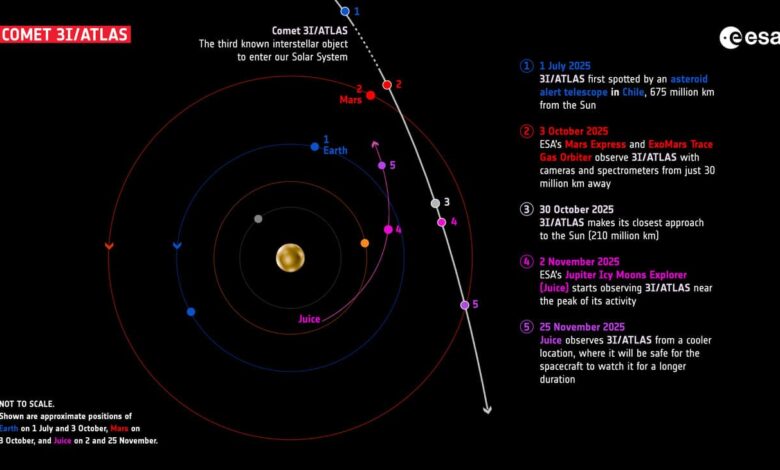
In October 2025, specialists from the European Space Agency (ESA) conducted a groundbreaking experiment: for the first time, data from an orbiter near Mars was used to refine the trajectory of the interstellar comet 3I/ATLAS. Until then, all calculations had relied solely on information gathered from ground-based telescopes.
In early October, comet 3I/ATLAS passed about 29 million kilometers from Mars. During this period, the ExoMars Trace Gas Orbiter (TGO), orbiting the Red Planet, was reoriented to observe this rare object. Engineers had to adapt the CaSSIS camera, originally designed for imaging the Martian surface, so it could capture the comet against a backdrop of stars.
The technical challenge was considerable: astronomers needed to account not only for the comet’s position but also for the precise coordinates of the orbiter around another planet. This required coordinated work between several ESA teams and partners, as well as adjustments to standard astrometry methods. As a result, the accuracy of predictions for 3I/ATLAS’s path increased tenfold.
For the first time, the obtained measurements were officially entered into the international Minor Planet Center (MPC) database, which compiles data on small bodies in the Solar System. This marked an important milestone in developing methods for observing interplanetary and interstellar objects using automated stations beyond Earth.
ESA noted that while 3I/ATLAS poses no threat to any planets, the observation experience proved extremely valuable for improving planetary defense systems. The agency regularly monitors potentially hazardous asteroids and comets to respond promptly to possible threats.
The ExoMars TGO experiment demonstrated that spacecraft orbiting other planets can significantly increase the accuracy of astronomical observations. This opens up new opportunities for studying objects passing through the Solar System and enables more effective coordination among international scientific teams.
In the future, such methods could become standard for monitoring interstellar objects and for early warning of potential space threats. The success of the ExoMars TGO mission was a significant contribution to the advancement of astronomy and strengthened Europe’s position in space research.