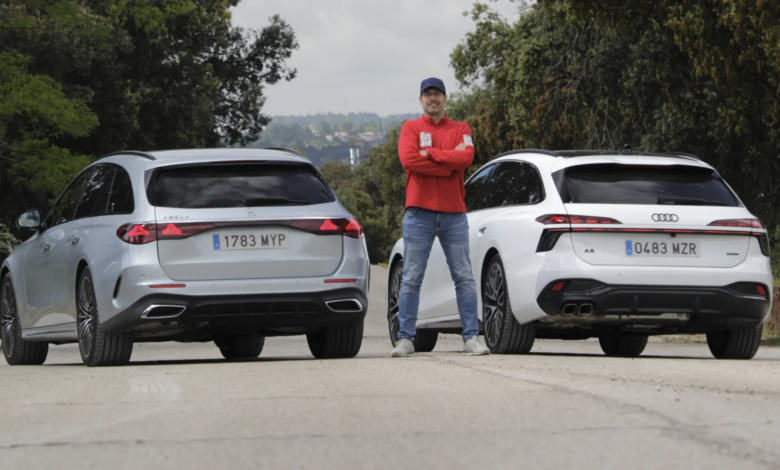
Two German station wagons, long regarded as symbols of status and comfort, once again find themselves on opposite sides of the battlefield. In 2025, the Audi A6 Avant and Mercedes E Estate continue their rivalry for the attention of families who value space, efficiency, and modern technology. Both vehicles promise top-level comfort on long journeys, but their differences are evident at first glance.
With the winter holidays approaching, the question of choosing a family car becomes especially relevant. The Mercedes E Estate and Audi A6 Avant offer diesel engines with low fuel consumption, automatic transmissions, and all-wheel drive systems. Each aims to set the standard in its class, presenting its own vision of the ideal family car.
Exterior and dimensions
The Mercedes E Estate greets you with classic shapes and smooth lines that emphasize its solidity. Its dimensions are impressive: nearly 4.95 meters long, 1.88 meters wide, and 1.47 meters high. Thanks to a low drag coefficient, this estate not only looks elegant but also delivers efficiency on the highway.
The Audi A6 Avant is slightly longer—almost 5 meters—a bit taller, but matches its rival in width. The Audi’s design is more aggressive: the signature Singleframe grille, sharp headlights, and a dynamic silhouette with a prominent rear spoiler. From the side, this Ingolstadt estate looks more streamlined than its Stuttgart competitor.
Audi’s wheel sizes start at 20 inches, while Mercedes starts at 18, but both manufacturers offer options up to 21 inches. The Audi’s rear emphasizes its sporty character, while the Mercedes stays true to classic design.
Trunk Space and Practicality
For a family car, trunk volume is one of the key parameters. Here, the Mercedes E Estate is clearly in the lead: 615 liters in standard configuration, and up to 1,830 liters with the seats folded down. This is one of the best results in its segment.
Despite its greater length, the Audi A6 Avant offers 466 liters, or 1,496 liters with the seats down. Mercedes wins not only in volume but also in convenience: the low loading threshold and efficient use of space make it more practical for transporting bulky items.
Both wagons feature rear seatbacks that fold in a 40/20/40 split, allowing you to carry long items—such as skis or sports equipment.
Interior and Technology
Inside, both cars offer plenty of space and a high level of equipment. In the Audi A6 Avant, rear passengers enjoy extra headroom, and two adults can sit comfortably. The Mercedes E Estate is slightly wider, allowing three passengers to feel less cramped.
The front cabin of the Mercedes emphasizes classic luxury, while Audi focuses on digital technology. The A6 Avant is equipped with an MMI Panoramic Display with 11.9- and 14.5-inch OLED screens, as well as an additional optional panel for the passenger.
Mercedes is not far behind: the E Estate offers 12.3- and 14.4-inch displays, as well as the MBUX Superscreen system with three screens under a single glass surface and a privacy filter. Audi’s interior is driver-oriented, while Mercedes prioritizes symmetry and comfort.
Both wagons come equipped with modern features: matrix LED headlights, adaptive cruise control, 360-degree cameras, parking assistants, massage seats, multi-zone climate control, and full integration with Apple CarPlay and Android Auto.
Engines and fuel consumption
The Mercedes E 220d 4Matic is powered by a 197 hp diesel engine, a mild hybrid system, all-wheel drive, and a 9-speed automatic transmission. The Audi A6 Avant TDI quattro offers 204 hp, also with a micro-hybrid setup, all-wheel drive, and a 7-speed S tronic gearbox—sportier, but less smooth at low speeds.
When it comes to fuel consumption, Mercedes performs better: it uses just 6 liters per 100 km on the highway, while both models consume around 7–8 liters in the city. Audi fights back in dynamics: thanks to a 1.7 kWh battery, it can run on electric power at low speeds—a feature Mercedes lacks.
The Mercedes boasts higher torque at 440 Nm, providing confident acceleration, although the Audi reaches 100 km/h faster—8.4 seconds compared to a slightly longer time for its rival.
Comfort and pricing
Both wagons offer a high level of comfort. Mercedes stands out with a softer suspension, while Audi delivers more precise handling and a sportier setup. Air suspension is available as an option for both models and significantly improves ride smoothness.
The Mercedes E 220d 4Matic Estate starts at around €70,000, while the Audi A6 Avant TDI quattro is priced from €76,000. With additional options, the final price can easily exceed €85,000, highlighting the premium status of both vehicles.
In case you didn’t know, Mercedes-Benz is one of Germany’s oldest car manufacturers, founded in 1926, while the Audi brand appeared in 1909 and is now part of the Volkswagen Group. Both manufacturers are renowned for their innovations in safety, comfort, and technology, and their station wagons are traditionally considered the benchmark among premium family cars.