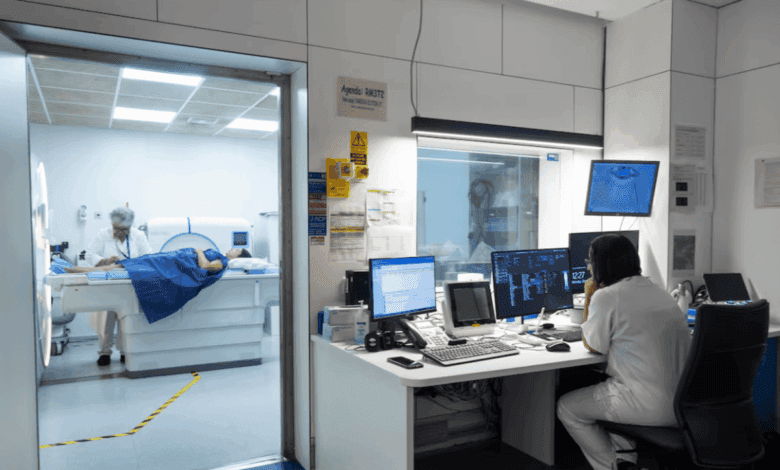
Valencia’s largest hospital, La Fe, is now home to Spain’s first prototype of a high-precision positron emission tomography (PET) scanner designed for brain research. The new device, named Helmet-PET, was developed by Spanish engineers and is already undergoing clinical trials. More than four million euros were invested in its development, with support from state research institutions and biomedical consortia.
The main feature of this scanner is its ability to capture real-time images of brain activity with high resolution. Thanks to innovative technology, the device is more sensitive, requires a smaller dose of radiopharmaceuticals, and offers patients greater comfort during the procedure. This is especially important for people with heightened sensitivity and elderly patients.
A new era in diagnostics
The introduction of Helmet-PET opens up new possibilities for early detection of neurodegenerative diseases such as Alzheimer’s. Doctors can now register even the slightest changes in the brain at the very earliest stages, something that was virtually impossible before. The scanner also allows for frequent and safe monitoring of disease progression and enables visualization of brain areas that were previously inaccessible.
The device will also be used to diagnose tumors, epilepsy, movement disorders including Parkinson’s disease, as well as to assess the consequences of stroke and certain psychiatric conditions. Such a wide range of applications makes Helmet-PET an indispensable tool for modern medicine.
Innovative design and artificial intelligence
Unlike traditional PET scanners, the new device is shaped like a helmet, ensuring a snug fit around the head and greater accuracy during examinations. Thanks to its modular design and ergonomic features, the device easily adapts to any patient—whether in a wheelchair, lying down, or seated. The package includes a motorized chair that can be adjusted to meet individual needs.
The images obtained are processed using advanced artificial intelligence algorithms. This allows for rapid data analysis and highly informative results. Physicians note that the new technology not only speeds up the diagnostic process, but also makes it less stressful for patients.
Spanish technology at a global level
Minister of Science and Innovation Diana Morant stressed during her visit to the hospital that the launch of Helmet-PET puts Spain among the world leaders in neuroimaging. According to her, the government is actively investing in the development of advanced medical technologies to ensure citizens have access to the best diagnostic and treatment methods.
Morant emphasized that the new scanner is the result of collaboration between government institutions and private companies. This approach not only enables the creation of unique medical solutions but also supports local engineers and scientists. The project was financed within the framework of the innovation development program, with support from the European Union.
Valencia’s Contribution to the Future of Medicine
Regional Health Department head Marciano Gómez stated that Valencia was chosen for clinical trials of the new equipment in recognition of the region’s high level of medical expertise. According to him, the region has long established itself as a center for cutting-edge medical research and innovation.
Gómez stressed that the implementation of Helmet-PET is not just a step forward for Valencia, but also a contribution to the advancement of the entire Spanish healthcare system. He also highlighted the importance of attracting and supporting young scientists, without whom further development of medical technology would be impossible. New professional categories are already being created in the region for researchers and medical specialists.
Future Plans and New Developments
As part of Spain’s innovation program, another prototype of a high-precision scanner is being developed in Madrid. Nearly four million euros have been allocated for this project, and the device will soon be installed for testing in one of the capital’s clinics.
The successful implementation of such projects is expected to position Spain as a leader in medical diagnostics and attract the attention of the international scientific community. In the coming years, these new technologies will become available not only in major cities, but also in other regions of the country.