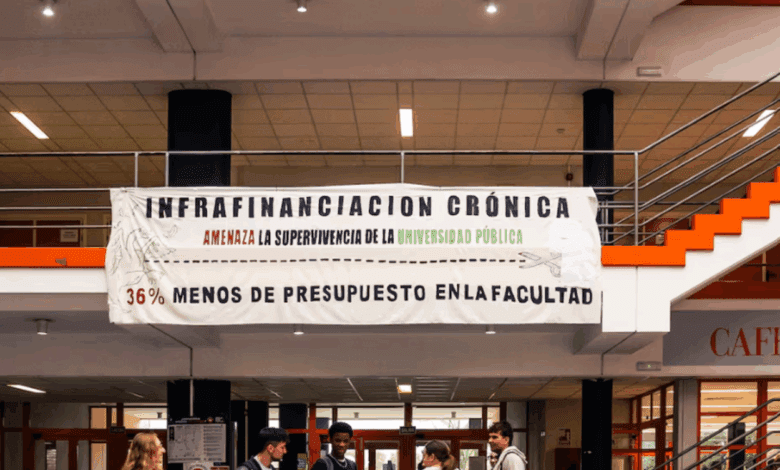
In 2021, five leading public universities in Madrid found themselves at the center of a scandal: over 500 employees received retirement bonuses totaling more than 10 million euros, despite a lack of legal grounds for such payments. These bonuses, intended for staff retiring due to age or early retirement, were issued in violation of budgetary restrictions in effect at the time. Financial reports for that year revealed not only the fact of the payouts but also instances where the amounts exceeded the maximum allowable pension, as well as cases where bonuses were granted to people who had not reached the required age.
Inside university walls, tensions ran high: unions and administrators are trying to find ways to preserve the bonus despite pressure from the regional government. The issue of funding higher education in Madrid has long been a bone of contention between university rectors and the regional authorities, and now this scandal has made the situation even more complicated.
Background of the payouts
The tradition of retirement bonuses dates back to collective bargaining agreements reached in the late twentieth century, when universities secured the right for their employees to receive additional payments upon retirement. However, after the financial crisis of 2012, regional authorities imposed a strict ban on such bonuses, in effect from 2013 to 2021. Despite this, some universities continued to award bonuses to those who had acquired the right before the ban came into force.
The University Complutense (Universidad Complutense de Madrid, UCM) led in total payouts, distributing almost 7 million euros over the year. It was followed by the Polytechnic University (Universidad Politécnica de Madrid) with 2.3 million, and by the universities of Alcalá (Universidad de Alcalá), Carlos III (Universidad Carlos III de Madrid), and Rey Juan Carlos (Universidad Rey Juan Carlos), where the sums were considerably smaller but the approach was similar.
Financial crisis in universities
Today the future of these additional payouts remains uncertain. The formal ban has been lifted, but now universities face a new challenge—a severe lack of funds. For example, UCM is forced to operate under strict austerity, as it must repay a regional loan of 34.5 million euros plus interest, taken out to cover salaries and ongoing expenses. This means a one-third reduction in spending, which has already led to cuts in support for innovative projects, hiring delays for new faculty, and reductions in research grants.
In this context, the idea of continuing pension bonus payments seems increasingly questionable—especially after auditors pointed out there were no legal grounds for such bonuses and uncovered cases of exceeding maximum pension limits and payouts to employees who had not yet reached retirement age.
Different approaches
The situation varies at other universities. At Universidad Autónoma de Madrid, former staff have been holding public protests for years, demanding the reinstatement of promised payments. Bonuses there were canceled back in 2012 and have not returned, despite the region’s economic growth. Unions remind that the current rector pledged to review the incentive system, but so far only modest sums, nowhere near previous levels, are being discussed.
At Universidad Rey Juan Carlos, considered a relatively young institution, only 15 people received bonuses in 2021. In Alcalá, 16 people did, and in Carlos III, 19. Auditors found violations at these universities as well: payments were made automatically, without applications from employees and without any formal decisions from the administration.
Issues and prospects
At the Polytechnic University, where the staff is aging, the number of pension bonuses was the second highest after UCM—83 cases in a year. At UCM, there were nearly 400 such payments. Auditors noted that in some cases, the sums exceeded the maximum allowed by law, and some employees received bonuses without meeting the age or service requirements.
Overall, the issue of pension bonuses at Madrid universities has become a litmus test for the entire higher education funding system in the region. While some institutions try to preserve the tradition, others are being forced to abandon it due to a lack of funds. Against this backdrop, questions of fairness and legality around such payments are increasingly pressing, leaving the future of the incentive system uncertain.