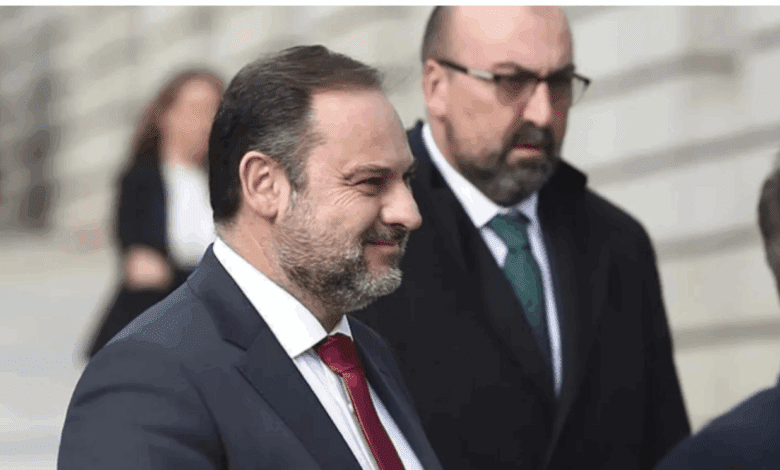
It has been exactly one week since former minister José Luis Ábalos was remanded in custody by court order. Today, his defense team filed an official appeal against his detention, insisting that none of the reasons cited by Judge Leopoldo Puente withstand scrutiny. According to the lawyers, the pre-trial detention measure is being used solely to pressure the accused into cooperating, rather than due to any genuine risk of flight.
In the brief submitted to the Supreme Court, the lawyers stress that none of the usual grounds for pre-trial detention are relevant in this case. They believe the court’s decision is simply an attempt to repeat the approach used with another defendant in the case, Víctor de Aldama, who gave a confession after time in prison.
Defense arguments
Judge Puente sent not only Ábalos but also his former adviser Koldo García to prison, acting on requests from the anti-corruption prosecutor and an indictment supported by the Partido Popular. The main reason—allegedly, a high risk of flight. However, lawyer Carlos Bautista argues that the judge failed to explain why he considers this risk real and did not present a single convincing fact.
In their appeal, the defense points to inconsistencies in the conclusions of the Central Operational Unit of the Civil Guard (Unidad Central Operativa, UCO). Specifically, they refer to a disputed financial report and testimony from a repentant witness, which, according to the lawyers, are based on assumptions rather than facts. Baustista emphasizes that there is not a single piece of direct evidence in the case file linking Ábalos to the missing money or to regular payments that, according to Aldama, García allegedly received.
Criticism of the investigation
Lawyers for the former minister note that during the time Ábalos held office (from June 2018 to July 2021), his expenses were covered by the state, so he had no need to withdraw large sums or make significant expenditures. At the same time, they argue the Civil Guard’s reports are based on conjecture rather than concrete evidence.
The defense also points out that the court did not explain why it considers the flight risk to be ‘extremely high.’ They argue that Ábalos’s circumstances have not changed before or after the preliminary hearing, so there was no basis to impose stricter pretrial measures.
Prosecution’s position
The prosecution, on the other hand, insists that the risk of the former minister fleeing is very real. This is why the prosecutor’s office supported the request to place him in custody. However, the defense believes that the only thing that has changed recently is the appearance of indictments demanding lengthy prison terms.
The appeal emphasizes that the difference between release and arrest lies only in the fact that formal charges have now been filed, not in any change of circumstances or discovery of new evidence. The defense argues that the pretrial detention is unwarranted and should be revoked.
Next steps
The Supreme Court must now review the defense’s arguments and decide the fate of the former minister. If the appeal is granted, Ábalos could be released before the trial begins. If the court finds the arguments insufficient, the ex-minister will remain in custody until the investigation concludes.
Notably, José Luis Ábalos has been a prominent figure in Spanish politics in recent years. He served as Minister of Transport, Mobility and Urban Agenda from 2018 to 2021, and prior to that was a member of Congress from the Socialist Party. His name has been linked to several high-profile political and corruption scandals, yet until recently he managed to avoid serious consequences. Now, Ábalos’ fate depends on the Supreme Court, which must assess whether his detention is justified.