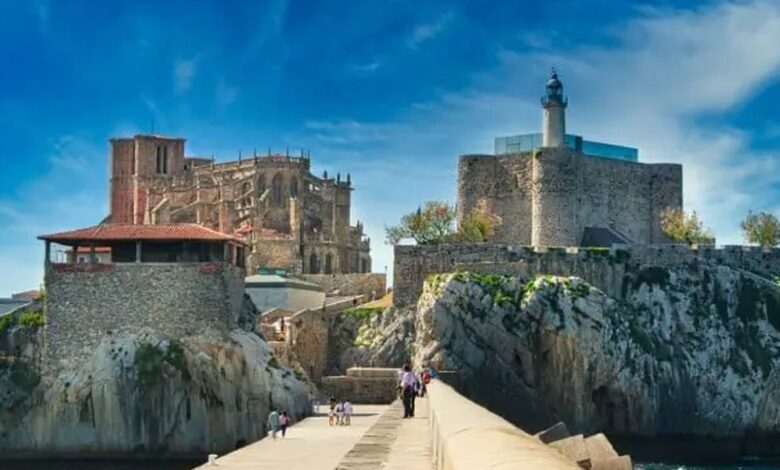
The northern shores of the Iberian Peninsula are dotted with silent witnesses of the past. Among them stands out a fortification that rises directly above the turbulent waters of the Cantabrian Sea. It dominates the coastal town, offering visitors a breathtaking panoramic view. The atmosphere of this place, still imbued with legends and echoes of past battles, remains pervaded by the austere spirit of the Middle Ages.
The history of this bastion began in the 12th century, around 1163, during a time of prosperity for the local settlement. With its pentagonal layout and massive stone fortifications, it was built as a defensive stronghold to protect the fishing community. Nearby rose the majestic church of Santa María de la Asunción, and together they formed an architectural ensemble that still leaves a striking impression. This is the landmark in Castro-Urdiales, which has become a symbol of the fusion of history, the power of the sea, and northern traditions.
The strategic location of the citadel was meticulously thought out. It was part of a network of defensive lines that protected both the upper part of the city with its church and the medieval quarters. In times of danger, residents could quickly evacuate by sea thanks to the citadel’s proximity to the cliffs and the port. This feature proved crucial during the French occupation in 1813. The fortifications became the last line of resistance against Napoleon’s troops. When the city fell, many residents managed to escape by boarding English ships from this very place.
In the 19th century, the complex was enhanced with a new addition—a navigation tower that remains operational to this day. Its light was first lit in 1853. Attached to the ancient stonework, the tower creates an unforgettable image: medieval masonry alongside a maritime lantern, united against the backdrop of the Bay of Biscay. For more than a century and a half, its light has guided ships approaching the city, underscoring its deep connection to seafaring. The scene is completed by an old bridge, often mistakenly called Roman, though it was built in the Gothic style. Its single arch once led to the small chapel of Saint Anne, another site steeped in history. Beneath its parapet, a stone engraved with letters and numbers remains—possibly a record of one of its many restorations.
But the history of this place also includes darker chapters. During the years of civil conflict, it was used as an improvised prison for supporters of both warring sides. This fact attests to the reliability and impregnability of its construction. Even today, divers find cannons at the foot of the cliffs, thrown into the water from above—tangible evidence of the violent events that once unfolded around this fortress.
Time, however, has been kind to this monument. Having lost its military significance, it has been transformed into a space open to everyone. Today, exhibitions are held here, cultural events take place, and most importantly, visitors are offered a unique experience. Walking along its perimeter, gazing at the boundless surface of the water, and listening to the waves crashing against the rocks leave an unforgettable impression.