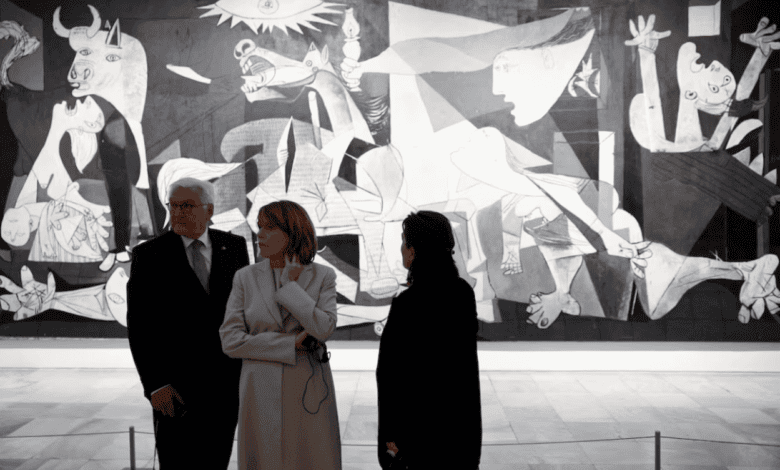
On Friday in Gernika, a ceremony took place that became a landmark event for all of Europe. German President Frank-Walter Steinmeier personally asked forgiveness from the residents and descendants of the victims of the tragic bombing of the city that occurred on April 26, 1937. At that time, Nazi aviation, supporting Franco’s regime, reduced Gernika to ruins, and the event itself became a symbol of the horrors of war and inspired Pablo Picasso to create his renowned painting.
For the first time, the head of the German state arrived in Gernika to offer condolences not just in writing, as had been done before, but in person, at the site where the victims are buried. The ceremony was held at the Zallo cemetery, where the remains of the victims rest, as well as at the Gernika Peace Museum. The president was accompanied by King Felipe VI of Spain, for whom this visit to the city was also his first.
During the visit, Steinmeier noted that the crimes committed by German aviation are still a source of pain for Basque families. He emphasized that the memory of the tragedy lives on, and the lessons of the past must serve as a warning for future generations.
A visit rich in symbolism
The three-day official trip of the German president and his wife concluded in the Basque Country. During his stay in Spain, Steinmeier repeatedly stressed the importance of acknowledging historical responsibility. He was accompanied by King Felipe VI, who visited Gernika for the first time, continuing the tradition started by his father Juan Carlos I in 1991.
The ceremony was attended by representatives of various political forces: the Socialists, the People’s Party, nationalists from PNV, and the Sumar coalition. The Basque government leader, Imanol Pradales, hosted a reception for the German delegation at the Ajuria Enea residence and also took part in the commemorative events.
However, not all political groups supported the visit. The EH Bildu party declined to attend, stating that they considered King Felipe VI’s participation offensive to the memory of the victims. Despite this, most politicians and public figures saw the gesture by the German president as an important step toward reconciliation.
Meeting with survivors and words of gratitude
A special part of the program was a meeting with two women who survived the bombing—Crucita Etxabe and Mari Carmen Aguirre—both now in their nineties. Their stories of the events of 1937 served as a reminder that the pain of war does not fade with time.
During an official dinner in Madrid, King Felipe VI expressed his gratitude to the German president for his gesture, calling the visit to Gernika a symbol of reconciliation and a reminder of the consequences of totalitarianism. He emphasized that such actions help to strengthen trust between nations.
Basque government leader Imanol Pradales earlier called on the Spanish state to also recognize its responsibility for the suffering caused by Franco’s dictatorship and the injustices endured by the people of the Basque Country.
Contemporary challenges and European values
During the visit, the President of Germany met with Spanish Prime Minister Pedro Sánchez at the La Moncloa residence. Sánchez thanked Steinmeier for visiting Guernica and noted that Germany sets an example of responsible engagement with historical memory. He added that Spain is also working to come to terms with its past, especially in the year marking the 50th anniversary of Franco’s death.
During the talks, the leaders of both countries voiced concern over the rise of extremist sentiment in Europe. They stressed that only unity among democratic forces and constructive solutions can protect European values and prevent a repetition of past tragedies.
The ceremony in Guernica was not only an act of remembrance, but also a reminder of the need to preserve historical truth and build a future based on respect and dialogue. For many residents of the Basque Country, this day marked an important step toward healing old wounds.