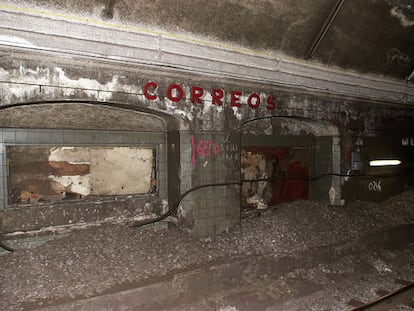
In the heart of Barcelona, beneath the bustling Via Laietana, a metro station long thought forgotten has come back to life. Correos, closed since 1972, opened its doors for a few hours to welcome curious locals and visitors. Over the decades, the underground stop has become a legend among urban history and transport enthusiasts.
The station is located between Jaume I and Barceloneta, directly beneath the post office building. Opened in 1934, it operated for nearly forty years before being decommissioned due to line expansion and the short distance between adjacent platforms. On that night, when the metro was shut down, small groups of people descended into the tunnel to walk along the tracks and enter a space where time seemed to stand still.
Inside, old signs, advertising posters, and even propaganda materials from Franco’s era have been preserved. The original lighting fixtures and tiles, which in 1956 were replaced by the famous ‘metro grey’, drew particular attention. Interestingly, this was the first place in Spain to use fluorescent lighting—a real technological breakthrough for its time.
However, despite the excitement surrounding the reopening, authorities do not plan to make Correos a permanent part of the route. It’s too complex and costly to halt train traffic and change service schedules for guided tours. Moreover, the station has no separate street entrance—access is only possible via the tunnel when trains are not running.
At one time, Correos was not considered a major transport hub: just a single platform and constant problems with dampness due to its proximity to the sea. Yet it was exactly this authenticity and unique atmosphere that turned it into a magnet for urbanism enthusiasts. Today, everything remains just as it was on the day it closed—even the smallest details have been left untouched.
As part of the centenary of the Barcelona metro, other unusual sites have also opened: the Santa Eulàlia workshops, the Mercat Nou power station, the traffic control center, and another ‘ghost’ station, Gaudí, which never welcomed a single passenger, but has its own entrance from the street.