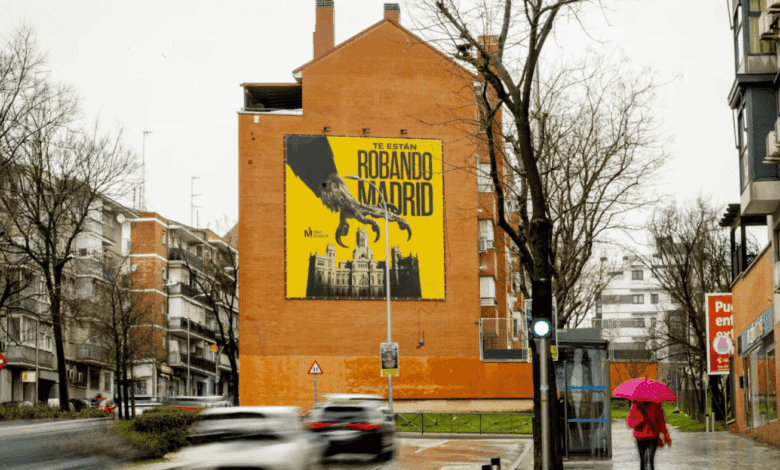
A new conflict has erupted in Madrid, directly affecting thousands of city residents. Massive banners with provocative messages have appeared on the facades of several buildings, suggesting that the city is literally slipping away from its inhabitants. This campaign is more than just another attempt to highlight the housing issue—it’s stirred public opinion and cast doubt on the policies of municipal and regional authorities.
The issue of housing affordability in Madrid has long been a cause of concern for locals. In recent years, rents have risen so sharply that for many families and young people, independent living has become an unattainable dream. Against this backdrop, the appearance of posters accusing speculators and politicians sparked a strong reaction—both among residents and government representatives.
Symbols of protest
The buildings chosen for the banners were not accidental. These are homes where residents have already faced pressure from new owners, often representing the interests of large investment funds. Addresses like Gaztambide 37, Tribulete 7, Valverde 42, and Mazaterón 8 have become symbols of the fight against evictions and the conversion of residential neighborhoods into luxury complexes or tourist apartments.
People have lived in these homes for decades, but now they face eviction to make way for new developments. The situation is especially acute in areas where social housing was sold to private companies and later resold to so-called ‘vulture funds.’ For many families, this means not only losing their roof over their heads but also breaking vital social ties.
Politics and Accusations
The campaign launched by Más Madrid targets not only private investors, but also the decisions made by city and regional authorities. According to organizers, it is recent policies that have created conditions in which real estate speculation has become the norm. As an example, they point to the sharp rise in rental prices, lack of regulation for tourist apartments, and the decline in affordable housing for young people.
Public statements include accusations against the mayor and the regional head, who, according to activists, support the interests of wealthy investors rather than ordinary residents. While some people are gaining new opportunities, others face endless queues, bureaucracy, and constant bills. On social media, people are debating how the cityscape is changing and who truly benefits from these changes.
Voices of the Streets
Recent protests in the Malasaña area have drawn particular attention, where residents of Valverde 42 took to the streets to voice their displeasure at yet another eviction attempt. These events continue a series of conflicts between tenants and new property owners eager to profit quickly from real estate in prestigious neighborhoods.
Other districts, such as Vallecas and Chamberí, are experiencing similar tensions. Here, entire families face the threat of homelessness due to plans for luxury apartment developments. For many, this is not simply about housing, but a fight to remain part of their community and preserve their way of life.
Public Initiative
Más Madrid did not limit itself to street demonstrations. The party organized a petition drive calling for restrictions on speculative transactions and a cap on rental prices. In addition, movement representatives plan to meet personally with residents of affected areas to listen to their proposals and collect real stories about how life in the capital is changing.
A well-known creative director designed the campaign’s posters and visual branding, adding to its distinct identity. As a result, the discussion of the problem spread far beyond political circles and became a talking point across a wide spectrum of society.
A City Divided
The focus is not only on housing issues, but also on the general state of the city’s infrastructure. Residents complain about worsening public transport, overcrowded hospitals and schools, as well as the uneven distribution of city resources across different districts. Many believe that current policies are making wealthy neighborhoods even more privileged, while poorer areas are increasingly neglected.
While the authorities limit themselves to general statements about Madrid’s appeal to investors and tourists, ordinary residents face real challenges. For them, housing is not just an economic issue but also a matter of justice and the right to the city.