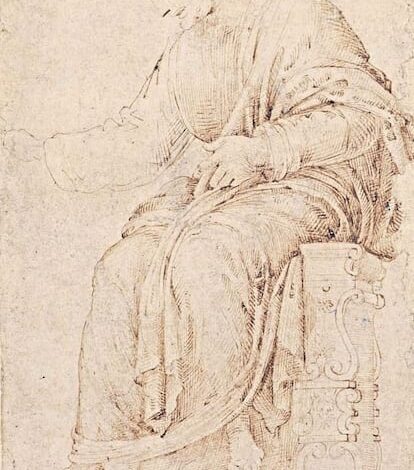
In 2019, the art world was captivated by interest in a drawing recognized as one of Michelangelo Buonarroti’s earliest works. The sketch, created when the future master was about fifteen years old, is known as the “Study of Jupiter.” Acquired in France in the late 1980s, this sheet remained anonymous for a long time until it was attributed by a British collector and later exhibited in Budapest.
The drawing was inspired by the ancient Roman sculpture “Jupiter Enthroned,” which, in the 15th century, was part of a private collection in Rome. At that time, Michelangelo had not yet visited the Eternal City and was working in the Ghirlandaio brothers’ workshop in Florence. It was there that he began learning sculpture and created his first known relief, “Madonna of the Stairs,” which experts believe is also linked to this early drawing.
Today, Michelangelo’s drawing is held in a private collection and is exhibited through a London gallery. However, its history extends far beyond Italy, unexpectedly intersecting with Spain—specifically, Valencia. This raises the question: how are the early works of the young Michelangelo connected to this region, considering the artist himself never visited the Iberian Peninsula?
The answer lies in the so-called Codex Escurialensis—a collection of Italian drawings from the late 15th century, which became part of the renowned library of Rodrigo de Mendoza, Marquis of the Cenete and one of the most influential aristocrats of Valencia and Guadalajara. This manuscript, thoroughly studied by modern researchers, was brought to Spain in the early 16th century when Mendoza returned from Italy. Along with him came artists from the circles of Leonardo da Vinci and Filippino Lippi, who adorned the main altar of the Valencia Cathedral.
In this way, through the collections and cultural exchanges of the Renaissance, the ideas and techniques of Italian masters spread into Spain. The Codex Escurialensis became one of the key sources for Spanish artists of that era, while the early works of Michelangelo served as both examples to follow and sources of inspiration.
The discovery and study of these connections offer a new perspective on Valencia’s role in the history of European art. The influence of the Italian Renaissance on Spanish culture proved to be much deeper than previously thought, and finds such as an early drawing by Michelangelo are important evidence of this process.
Today, researchers continue to analyze how Italian artistic traditions were received and reinterpreted in Spain. Recent publications and exhibitions are uncovering previously unknown chapters of history, allowing a wide audience to learn more about how the cultural identity of Valencia and the entire country was shaped during the Renaissance.