In Santiago de Compostela, an old legend says that the first souvenir pilgrims took home was a scallop shell. In the Middle Ages, it served as proof that a person had truly reached the holy city. Back then, the shells were collected only in Galician estuaries, but today most of these souvenirs come from Ireland. Shellfish export companies have found a new way to profit from the popularity of the Camino de Santiago, making sure not a single shell goes to waste.
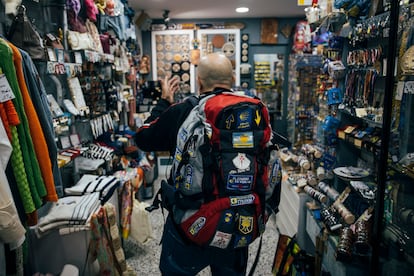
The symbolism of the pilgrimage route isn’t limited to shells. Miniature replicas of the famous Botafumeiro—the giant censer from the cathedral—are produced on Menorca, and over the past twenty years, the range of souvenirs has become truly international. Today, the historic center of Santiago is home to more than ninety souvenir shops, and the authorities have decided to stop issuing new licenses in order to prevent the city from turning into one big tourist marketplace.
Family dynasties like the Villar family remember a time when souvenirs were handmade by local artisans. But everything changed with the rise of mass tourism: now, magnets, pins, and figurines are produced in Chinese factories and shipped to Spain by the container load. Villar recalls traveling to China to find suitable manufacturers. At that time, they were small workshops with dirt floors; now, they have grown into large enterprises supplying the entire world. His warehouse in the O Tambre industrial zone stores thousands of items, and he is far from the only importer in the city.
Among the vendors, there are still those who preserve tradition. In a shop on Rúa do Franco, you can still find dolls in national costumes, hand-carved wooden figures, and other rare items crafted by artisans who are now nearly gone. However, demand for such products is declining: modern tourists prefer lightweight and inexpensive souvenirs—magnets, T-shirts, pins, and, of course, rosaries with the scallop and the cross of Santiago. Travelers’ habits have changed as well: few are willing to take home heavy or bulky items, and many no longer know what a Galician granary—hórreo—is, although it used to be a popular souvenir.
The souvenir trend has even reached tattoo parlors. Pilgrims now get Way symbols as keepsakes—from scallop shells to arrows showing the route. The cathedral hasn’t stayed away either: there’s now an official shop inside, where branded merchandise is sold. Some local vendors are unhappy with this, believing the church is turning into a marketplace.
City authorities are trying to address the dominance of souvenir shops and bring regular stores and housing for locals back to the city center. Santiago de Compostela is among the most visited cities in Spain, and the tourist flow has not waned since the mass pilgrimages began in the 1990s.
Sometimes the passion for unique souvenirs leads to the absurd. In the 1970s, well-known businessman José María Ruíz-Mateos tried to buy the real Botafumeiro, a silver censer weighing 60 kilograms, but was refused. He then spread a fake news story about the supposed theft, and to this day, a photo featuring the censer still decorates the family shop.
Among foreign tourists, wooden figurines of the apostle Santiago and the cathedral façade are especially popular. There are almost no local artisans left, but Argentine Óscar Martarelli, who works on Praza do Toural, still collaborates with one of the last sculptors. His shop is famous for unique patches indicating the distance to Santiago—over 1,700 options made to order in a Portuguese workshop. He even creates custom designs for pilgrims with children or from the most unexpected places around the world.
Souvenir production has become a true industry. Shells and crosses often come from Asturias, ceramic tiles from Andalusia, and hats from Valencia. But most of the cheap goods are made in China. Sometimes, curiosities appear: for example, one online platform sold a plaque with errors, where the name of the Camino was misspelled and the map of Spain looked as if it had been drawn by a child. Even such items find buyers—for €18.5.