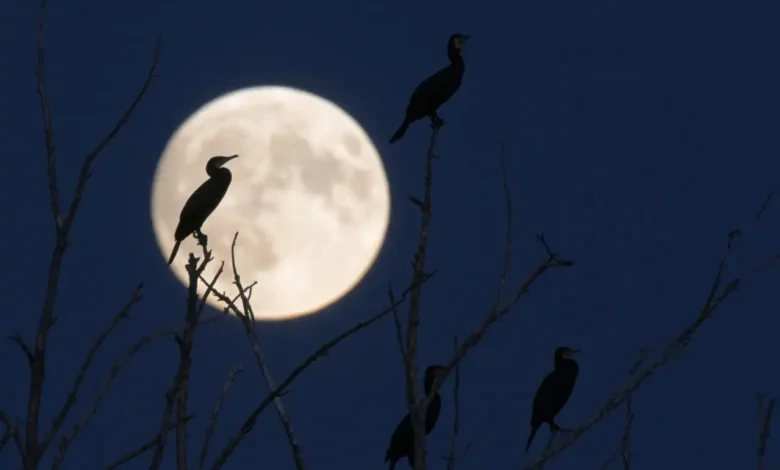
In October 2025, Spaniards will have the chance to witness one of the most spectacular events in the night sky — a supermoon. This time, the full moon will be closer to Earth than usual, appearing especially large and bright. Such a coincidence is rare, so astronomers and night sky enthusiasts are already preparing for this event.
Historically, the October full moon has been called the ‘Hunter’s Moon.’ In earlier times, before the advent of modern calendars, inhabitants of North America relied on the phases of the moon to determine the right time for harvesting and hunting. The October moon signaled the start of the meat preservation season and preparations for winter. Today, this name has been preserved, and each year in October, many people look forward to the appearance of this special moon.
In 2025, the supermoon will appear in the Spanish sky on the morning of October 7, but it will be best seen on the night of the 6th to the 7th. At that moment, Earth’s satellite will come to its closest distance to our planet — just over 361,000 kilometers, which is noticeably less than the average. As a result, the moon will appear about 6-7% larger and up to 14% brighter than usual. This is not just a visual effect — the distance between Earth and the moon will actually decrease.
Supermoon is a term that sparks debate among experts, as there is no clear scientific definition for it. It was first introduced by astrologer Richard Nolle in the late 1970s, describing the coincidence of a full moon with the closest approach of the Moon to Earth. Despite disagreements, for most people it simply means a rare chance to see the night sky’s brightest object in an unusual way, without using telescopes or other equipment.
If you miss the chance to see the supermoon in October, there’s no need to worry—two more similar moons are expected in November and December 2025, though in colder weather. Having three consecutive supermoons is a rare event in the lunar calendar. October will also offer other celestial events: meteor showers are expected, and it will be possible to observe planets and even some galaxies. At the end of the month, on October 26, clocks will switch to winter time, making the nights even longer. It’s a great opportunity to get out into nature and enjoy the beauty of the autumn sky.