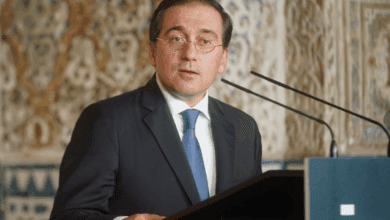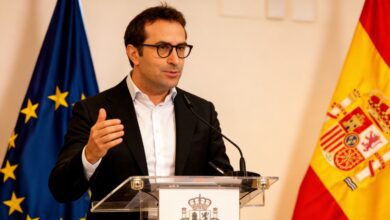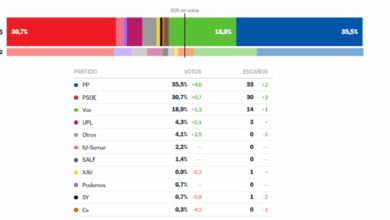
A new political conflict has erupted in Castilla y León, unexpectedly spilling beyond inner-party disputes. Local socialist leader Carlos Martínez has found himself at the center of attention following his remarks about regional identity, sparking a heated reaction among both politicians and the public.
It all began when Martínez, speaking at an event attended by Prime Minister Pedro Sánchez, tried to emphasize the importance of regional unity. However, his comments on ‘biregionalism’ and the naming of the autonomy were perceived as dismissive of León’s historical distinctiveness. This drew sharp criticism from the Unión del Pueblo Leonés (UPL) party and León’s mayor, José Antonio Diez, who is also a socialist.
At the heart of the dispute lies the fact that Castilla y León unites territories with different historical backgrounds. For many people in León, autonomy and self-governance remain highly sensitive issues. There is ongoing debate in the region about the possibility of creating a separate autonomy for León—an idea supported not only by local politicians but also by a significant number of municipalities.
Political ambitions and regional tensions
The mayor of León does not hide his disappointment with the party leadership’s stance. He emphasizes that for the residents of the city and the region, the issue of identity and the right to self-governance is not just a political slogan, but a fundamental part of their collective consciousness. In February, he even presented a legal opinion stating that creating a separate autonomy for León is possible under the current Constitution, provided the national parliament approves the proposal.
At the same time, the PSOE leadership in Castilla y León is trying to defuse tensions, urging a focus on combating territorial inequality and further decentralization. Party documents acknowledge the presence of pro-Leónist sentiments, but stress the importance of a unified policy for all nine provinces in the region.
Opposition reaction and public response
The UPL party, for whom León’s autonomy is a key policy priority, sharply criticized the socialists’ position. They argue that attempts to unite the interests of all provinces only lead to the further marginalization of León, Salamanca, and Zamora. As evidence, they point to population decline and worsening social and economic indicators in these provinces over recent decades.
In response to criticism, the socialist leader continues to insist on the need for a unified project for the entire region. He believes that only joint efforts will allow Castilla y León to overcome the prolonged crisis and achieve unified representation at the national level. However, the León branch of the party and local activists are not ready to abandon the idea of autonomy and are demanding respect for their identity.
The future of the region is in question
The scandal surrounding the remarks of Carlos Martínez has exposed just how deep the divisions run within PSOE and the entire region. The issue of León’s status has returned to the center of public attention, and political tension continues to grow. While party leaders try to maintain a balance between unity and regional identity, León advocates keep pushing for their right to self-governance.
It is clear that this conflict will not be resolved quickly. In the coming months, the question of León’s autonomy and relations between the provinces of Castilla y León will remain one of the main topics for local politicians and residents.