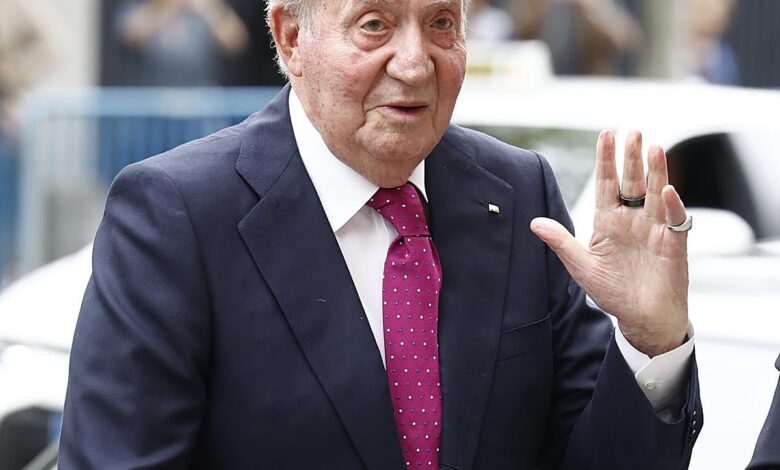
The high expectations surrounding the television interview of honorary king Juan Carlos I with French television burst like a soap bubble. The reason was the astonishing, and at times frankly contradictory, responses from the former monarch, which left viewers more puzzled than sympathetic. It is still unclear whether the interview will air in Spain, although some television hosts have already shown interest. In France, however, the conversation, recorded by journalist Stéphane Bern in Abu Dhabi, went almost unnoticed, drawing only about 6% of viewers and losing badly to a regular feature film airing at the same time. It seems the fate of Spain’s retired king holds little interest for the French public.
The interview served as a kind of prelude to Juan Carlos’s memoirs, titled “Reconciliation,” scheduled for release on December 3. During the conversation, the king presented his personal view of key events in Spanish history, interpreting facts to suit his narrative. This attempt to rewrite the past sparked a wave of criticism and doubts about the truthfulness of his statements.
His own version of history
One of the most controversial points was his account of his abdication. Juan Carlos I claimed it was entirely his own decision, and moreover, that his son, the current King Felipe VI, allegedly urged him not to step down. This assertion directly contradicts information from numerous journalists and experts close to the royal court, who maintain that the monarch’s departure was a forced measure under pressure from both circumstances and his own family. Such discrepancies with well-known facts cast doubt on his other revelations as well.
His recollections of the final days of dictator Franco also sounded rather unusual. According to Juan Carlos, the day before his death, Franco asked him “to take care of Spain.” However, historical records indicate that the dictator spent the last 20 days of his life in a coma and was unlikely able to hold meaningful conversations. He also presented his own version of events during the attempted coup on February 23, 1981, claiming he was completely isolated in the palace—again, at odds with testimonies from many participants in those dramatic events.
“I have no regrets”
The response to the interview was predictably negative, especially after the former monarch admitted he does not regret his mistakes. This applies to both the numerous financial scandals and his turbulent personal life, which ultimately led to his abdication. When asked directly about regrets, he replied, “I try not to have any.” Delivered with complete composure, this remark shocked many in Spain, where at least a formal apology was expected from him.
The interview was recorded back on November 5, and according to some sources, the king wanted to soften some of the more contentious points from his memoirs. He repeatedly emphasized his support for his son Felipe, but notably, throughout the conversation he never mentioned either Queen Letizia or his wife, honorary queen Sofía, further fueling rumors of a complete split within the royal family.
Life in Abu Dhabi and uncertain plans
Juan Carlos I also clarified the issue of his possible return to Spain. He stated that, for now, he is fully content in Abu Dhabi and does not feel any pressing need to go back home. He explained his numerous missteps simply: “Everyone makes mistakes,” showing complete indifference to public opinion on the matter. He admitted he is not particularly concerned about what others think of him.
Despite not expressing remorse for specific actions, he nevertheless apologized to his family and to Spaniards for “not being present enough” in their lives. At the end of the interview, he expressed hope that the Spanish people would ultimately understand his actions. In this way, the interview presented a monarch to the world who is trying to justify himself, quietly retreating from previous sharp statements while maintaining composure in the face of criticism. While his revelations attracted little interest in France, in Spain there is great anticipation for the publication of his memoirs, which are expected to be a true media bombshell.
RUSSPAIN reference. Juan Carlos I de Borbón was King of Spain from 1975 to 2014. He played a pivotal role in leading the country from Franco’s dictatorship to democracy, earning huge popularity and respect for decades. However, in the later years of his reign, the monarch’s reputation was seriously damaged by a series of scandals, including a costly elephant hunting trip in Botswana during Spain’s economic crisis and allegations of financial misconduct linked to his close associate Corinna Larsen. Under public pressure and amid deteriorating health, he abdicated in 2014 in favor of his son, Felipe VI. In August 2020, following new investigations into his financial affairs in Spain and Switzerland, Juan Carlos I left the country and has since been living in Abu Dhabi.