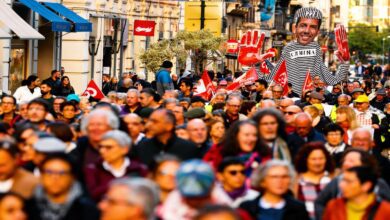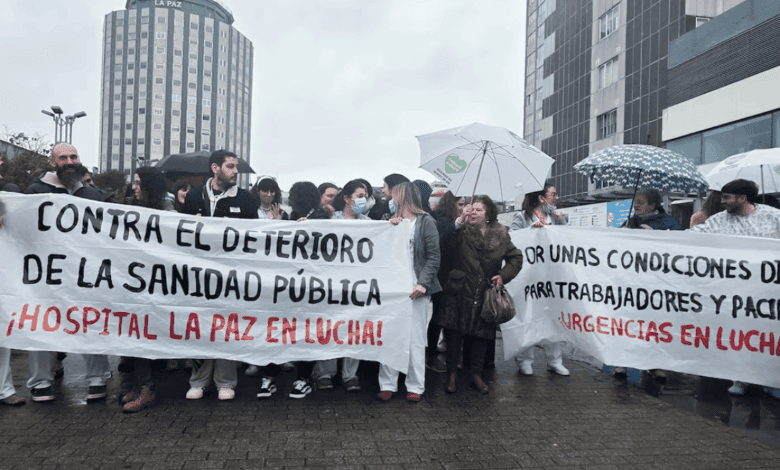
Despite heavy rain, dozens of staff from La Paz hospital, administrative employees, and ordinary Madrid residents gathered at the main entrance of the capital’s largest hospital. They were united not only by exhaustion but also by a sense of despair: patients are forced to wait for hours in overcrowded corridors, while medical staff are pushed to their limits. The symbolic strike by the adult emergency and trauma department staff became a cry for help — and, it seems, the last straw for many.
The hospital management set the minimum service level at 93%, effectively reducing the strike to a mere formality. Representatives from the Trabajadores en Red La Paz-Área Norte union called these conditions absurd and accused the administration of ignoring the staff’s real concerns.
Voices of Protest
Not only healthcare workers, but also politicians took part in the demonstration. The leaders of Más Madrid and PSOE, Manuela Bergerot and Mar Espinar, along with health spokesperson Marta Carmona, openly accused the regional authorities of driving the system to a breaking point. According to them, cutting nurses’ and orderlies’ salaries leads to a decline in the quality of care for all Madrid residents.
Bergerot did not hide her emotions: “This hospital is the pride of Madrid’s healthcare, but the authorities have pushed it to the edge. Departments are being closed, and those that remain are operating without doctors. Primary care is suffocating, and hospitals are falling apart. All so the healthcare budget can become a prize for private companies.”
She also announced plans to file a complaint with the prosecutor’s office regarding the management of Torrejón Hospital by Ribera Salud, and spoke about instances where staff were ordered to reuse disposable catheters to save money.
On the verge of burnout
Among the protesters was Alejandro Vilches, a nurse in the adult emergency department. He said he started the week in a 12-bed room that had 22 patients, with another seven waiting their turn in chairs. Some were in serious condition, some right in the corridor, without proper monitoring or equipment.
Vilches admits, “We’re used to being overwhelmed, but this is already dangerous for patients. It’s not just hard—it’s beyond human limits.” According to him, due to a spike in respiratory infections, beds are freed up only for the next patient to immediately take them. Sometimes patients have to be moved to chairs to make room for emergency surgeries.
Standing next to him was Rosa María Crespo, an admissions officer at the children’s hospital La Paz. She is outraged not only as a worker but also as the daughter of a patient: “My father, elderly and seriously ill, spent more than a day waiting for help. It’s humiliating and dangerous.”
Cutbacks and fatigue
One of the administrative staff members, who wished to remain anonymous, said that she used to be on duty once every two weeks, but now works almost every weekend. “We don’t have time to rest, and this fatigue affects the patients. Over 300 people pass through the emergency department each evening, but our staff has been cut in half. Since October, we’ve been working to the limit.”
Regional authorities, represented by Miguel Ángel García Martín, tried to downplay the scale of the strike, claiming that nobody supported it. In his view, protests should be held not at the hospital doors but at the Ministry of Health to demand more positions for doctors and nurses.
However, medical staff are convinced that the regional leadership is directly responsible for what’s happening. Gloria Hernanz, a junior healthcare worker, points out that even the minimum staffing requirements are not being met. “This morning, there were supposed to be six staff members in the emergency department, but only three showed up. The corridors are clogged with patients once again.”
Primary care crisis
Many protest participants are convinced: if patients have to lie in corridors, it means the primary care system is failing. “Of the 190 people who came in a day, half had a cold or earache. Everything funnels into a bottleneck,” says Hernanz. She’s calling for urgent investment in infrastructure: “The beds here are from 1961, everything’s falling apart.”
Protesters are demanding safe patient-to-staff ratios and the creation of additional spaces that can be quickly opened during patient surges. “Last night, we had 45 people in a ward meant for 32, and another had 28 when the norm is 12. You can’t work like this,” said Hernanz.
Representatives of civil initiatives also joined the protest. Raquel Boca from the movement for public healthcare stated: “We support the medical staff because this is a matter of life. Doctors work in terrible conditions, and public healthcare is shifting into private hands.”
Fear and responsibility
Doctors from nearby clinics came to support their colleagues. According to them, after the reform of the emergency care system, a third of the locations were left without full teams or doctors. “If primary care collapses, everything else will fall apart too,” said one doctor, who wished to remain anonymous.
A nurse from the La Paz emergency department admits, “Every day I go to work in a state of anxiety. I’m afraid I won’t be able to help everyone, and the risk of error is huge. For the past three months, I’ve had to submit explanations to the court almost every day because I couldn’t provide the necessary care.”
She calls this year the worst in all her years at the hospital: “It’s a ticking time bomb. It’s amazing a tragedy hasn’t happened yet. I’m ashamed to put patients in the corridor, but there’s simply no other choice.”