In early May 2024, off the coast of Gran Canaria, an event took place that is already being called a sensation for Spain’s entire marine science community. At a depth of nearly a kilometer, fishermen accidentally encountered a creature previously considered almost mythical for these latitudes. We’re talking about the so-called ghost shark—Mitsukurina owstoni, or the goblin shark. Until now, not a single live specimen of this species had ever been filmed in the Canary Islands.
The two-and-a-half-meter-long creature ended up in the nets during a routine fishing trip near San Cristóbal. Scientists who arrived at the scene wasted no time: they took a series of photos and video recordings before releasing the shark back into the ocean. The incident immediately sparked debate among biologists, as this is a highly rare species that has been documented fewer than 250 times worldwide since records began.
An unexpected visitor
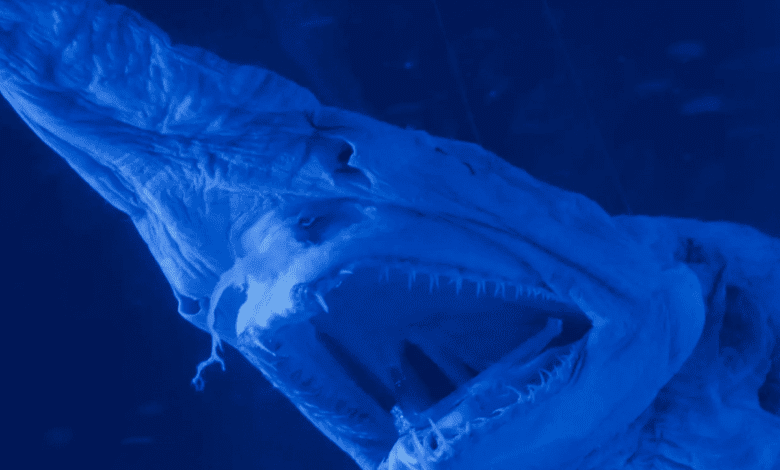
The appearance of Mitsukurina owstoni leaves no one indifferent. With its elongated, almost blade-like snout, tiny eyes lacking protective membranes, and fearsome jaws capable of protruding forward, it truly looks like something out of a deep-sea nightmare. Yet these very features allowed scientists to identify the species without hesitation. Based on morphological characteristics, the specimen turned out to be female, adding further intrigue to the discovery—sexual differences in this species remain poorly understood.
The images taken on site proved to be a true gift for the scientific community. They not only confirmed the identity of the mysterious visitor but also enriched the database on rare Atlantic inhabitants. For the first time in Canary Islands history, researchers obtained such detailed photographs of a living specimen, rather than just remains or random fragments.
Mysteries of the Deep
The goblin shark is not just a rare species—it’s a true ‘fossil’ predator, retaining features of its ancient ancestors. Its unusual appearance isn’t just an evolutionary curiosity: the elongated snout is covered in electroreceptors that allow it to detect the slightest movements of prey in total darkness. Adult goblin sharks can reach six meters in length and weigh more than 700 kilograms, though smaller individuals are more common.
Despite its fearsome appearance, Mitsukurina owstoni poses absolutely no threat to humans. It feeds mainly on small fish and cephalopods, and its way of life remains largely a mystery. All that is known is that the goblin shark prefers depths ranging from 250 to 1,500 meters, avoiding sunlight and steering clear of human attention.
An Untouched Ecosystem
The appearance of such a rare visitor near the Canary Islands is no coincidence. Since the 1980s, trawling has been banned here and deep-sea shark fishing is virtually nonexistent. Thanks to these measures, the region’s marine ecosystems have remained almost pristine. This is precisely what makes the Canaries a unique haven for endangered species.
Until now, Mitsukurina owstoni had been recorded in Macaronesia (which includes the Canary Islands, Madeira, and the Azores) only once. Now, the species’ distribution map has gained a new point, giving scientists fresh reasons to consider possible migration routes and breeding grounds of these elusive creatures.
Charting New Depths
The goblin shark’s presence in the Atlantic is highly uneven. In the east—off the coasts of Galicia, Madeira, Morocco, and Portugal—juveniles are found more often. On the western side, researchers encounter fully grown giants. This contrast may be connected to the species’ little-known breeding behaviors. Mitsukurina owstoni is ovoviviparous: its young hatch from eggs inside the mother and are born fully formed.
Constantly migrating and shifting to different depths as they age, these sharks elude close scientific scrutiny. The new sighting in the Canaries not only expands our understanding of the species’ range but also highlights just how little we know about life in the ocean’s dark zones. Each such discovery is a chance to lift the veil on deep-sea mysteries that remain out of reach even for today’s advanced technology.