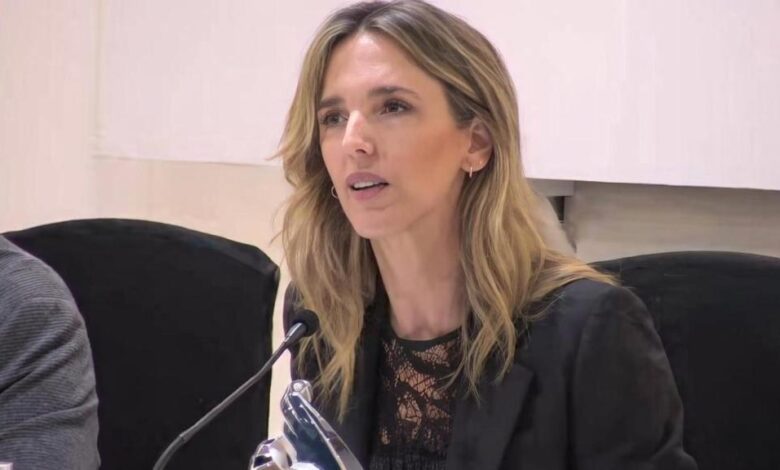
Another political storm has erupted in Spain: MP Cayetana Álvarez de Toledo has issued sharp accusations against the government, claiming that corruption in the Ministry of Transport goes far beyond financial misconduct and has already cost human lives. In the wake of the rail tragedy in Adamuz, she spoke with strong emotion, insisting that systemic flaws and cronyism within the ministry were the root causes of the disaster.
Speaking from the forum podium in Galicia, the MP went beyond general statements. She openly accused the country’s leadership of turning the ministry into a ‘personal playground’ for their inner circle, where key positions are filled not by professionals but by friends and associates of high-ranking officials. Her speech featured names and allusions to controversial appointments: the former advisor Koldo at Renfe, as well as women linked to ex-minister José Luis Ábalos who found themselves in top spots at subsidiaries of the railway giant and in Adif’s finance department.
“Corruption is not just about money, it’s about lives,” Álvarez de Toledo stressed, urging for an investigation into whether repairs on the accident site were carried out to standard. She expressed disbelief: how could a recently upgraded railway line fail so quickly? Her words carried a challenge: who will answer for the tragedy, and why has the ministry’s personnel system become a recipe for disaster?
Power and Appointments
The deputy also addressed the political aspect. In her opinion, the Ministry of Transport has become a symbol of the ‘Sanchismo system’, where personal loyalty takes precedence over professionalism. After Ábalos left, she said, the key position was not given to a compromise candidate, but to someone known for his aggressive rhetoric — Minister Óscar Puente.
Álvarez de Toledo presented her ‘Sanchismo decalogue’, highlighting six hallmarks: institutional takeover, disregard for merit, blind loyalty, propaganda, polarization, and lack of accountability. She is convinced that this toxic politics leads to real tragedies, and the country is rapidly declining. There was a tense silence in the hall as the deputy stated, ‘Citizens have the right to ask where their money is going.’
Her address also included criticism of the Prime Minister: ‘The state has become a tool in the hands of one person.’ Instead of reforms, there are deals and compromises dictated by blackmail. According to Álvarez de Toledo, this process began under José Luis Rodríguez Zapatero, but has now reached its peak.
Crisis and elections
The deputy insists the current head of government is not just leading the country, but steering it toward a ‘mutation’ — from real democracy to a mere façade. She claims that attempts to dismantle the system of checks and balances have so far failed, but the situation remains extremely dangerous.
As a solution to the crisis, Álvarez de Toledo sees no sense in hoping for internal changes within the ruling party or for a successful attempt to remove the prime minister through a vote of no confidence. The only way forward, she says, is new elections, although these too could, in her view, trigger another wave of instability. She warned that the current leader of the socialists might try to turn the corruption crisis into a constitutional one, putting the very political system of the country into question.
Her speech contained a note of irony: “Instead of choosing between the left and the right, we will be offered a choice between the monarchy of 1978 and some bright republic that doesn’t exist.” The deputy also accused the prime minister of trying to strengthen the position of Vox in order to prevent the opposition from winning.
A recipe for change
In conclusion, Álvarez de Toledo called for a “powerful reconstruction” of the state, based on transparency, efficiency, and a return to meritocracy. She insists the country needs a strong but flexible public administration capable of resisting corruption and inefficiency. In her view, it is essential to repeal laws that divide society and to cleanse institutions of political appointees.
The deputy emphasized, “We don’t need another Pumpido or Intxaurrondo, but people with impeccable reputations.” She identified “the courage to speak the truth” as the main weapon against corruption and mediocrity. Early in her speech, Álvarez de Toledo warned, “I am not here to polarize, but to politicize,” hinting that real politics is not about division, but about finding solutions.