Spanish law enforcement is facing a new level of sophistication in the fight against international drug trafficking. In Marbella, a shipment of cocaine hidden in cement bags was uncovered—an unexpected challenge for police, highlighting the inventiveness of criminal groups. This incident underscores how transnational gangs use legitimate channels to disguise their operations, with direct consequences for Spain’s security and economy.
Operation Amazona began after bags of cement arriving from Brazil, via the port of Algeciras, were found at an industrial warehouse in Marbella. The shipment appeared unremarkable, but some of the bags were discreetly marked with a faint X. These marks identified which bags concealed small packets of cocaine. According to El Pais, the shipment arrived in late summer last year, and not long after, police arrested three suspects who came to collect the goods.
Investigators found that the criminal group used a company registered in Bremen, Germany, to legitimize the import of a thousand cement bags. After arriving in Spain, the entire shipment was moved to a warehouse in Marbella, where the marked bags were intended for further transport of the drugs to Germany. In October, three individuals residing in Germany attempted to collect the cocaine but were caught in the act and detained.
International network
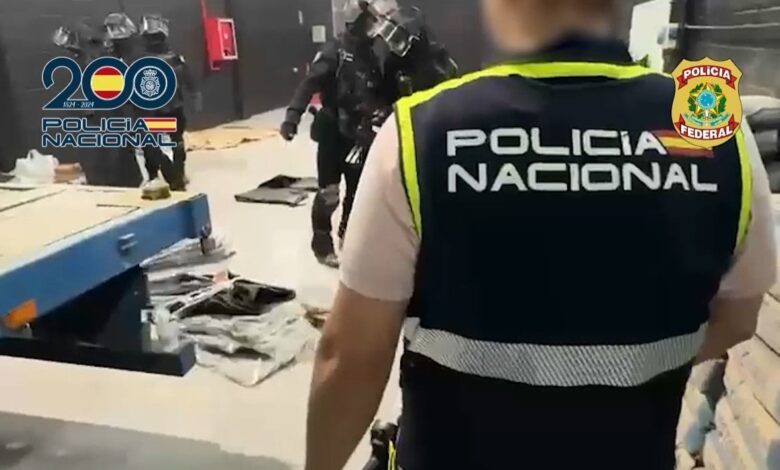
During the operation, police seized 1.5 tons of cocaine, packed in small bags and hidden among cement. All bags were marked for easy identification by those who were supposed to retrieve the drugs. As noted by El Pais, this method of hiding narcotics among construction materials is unprecedented—previously, criminals sometimes mixed cocaine with cement powder for later chemical extraction, but this time they used a different tactic.
Five people were arrested during the investigation: two German nationals, one from the Netherlands, one from Tunisia, and one from the United Kingdom. This lineup highlights just how international drug trafficking groups have become. Police also issued international arrest warrants for two more suspects, including an alleged leader linked to Mocro Maffia who lives between the Netherlands and Dubai.
The operation was supported by the Udyco Central unit, the Greco Costa del Sol group, and the Federal Police of Brazil. According to russpain.com, such joint actions between countries are increasingly important for countering global criminal networks that use legitimate companies and complex logistics to transport illegal substances.
Methods of concealment
The use of construction materials to conceal drugs is not the only example of criminal groups’ creativity. Last year in Spain, cocaine had already been found mixed with other cargo, but this time, the markings on cement bags represent a new stage in the development of such schemes. According to investigators, this allowed criminals to quickly locate the required bags among thousands of identical ones, minimizing the risk of detection.
Attention to detail and using legitimate businesses to cover operations are hallmarks of today’s drug cartels. In this case, a company from Bremen acted as an intermediary, making it harder to trace the supply chain. Police note that these schemes require customs to continuously enhance control measures and strengthen international cooperation.
Recalling other major investigations, it is worth noting that large-scale searches were recently carried out in Spain at offices of companies suspected of illegal shipments. For example, an operation to uncover violations in steel exports from the Basque Country showed that criminal schemes can affect all kinds of industries and regions.
Context and trends
In recent years, Spain has become one of the key transit points for drug trafficking from Latin America to Europe. The country’s ports are often used to import large shipments of illegal substances, and criminal groups are increasingly turning to innovative concealment methods. In 2025, a shipment of cocaine was discovered in Valencia hidden in fruit containers, while in Malaga, cocaine was found in loads of industrial equipment.
The increase in international operations and the involvement of citizens from different countries highlight the globalization of crime. In response, Spanish and European law enforcement agencies are strengthening information exchange and joint investigations. These measures make it possible to detect new schemes and prevent the spread of drugs within the EU.
According to El Pais, the fight against drug trafficking requires constantly updating methods and close cooperation between countries. Each new case, such as the discovery of cocaine in cement sacks, serves as a lesson for security services and an occasion to review freight control strategies.