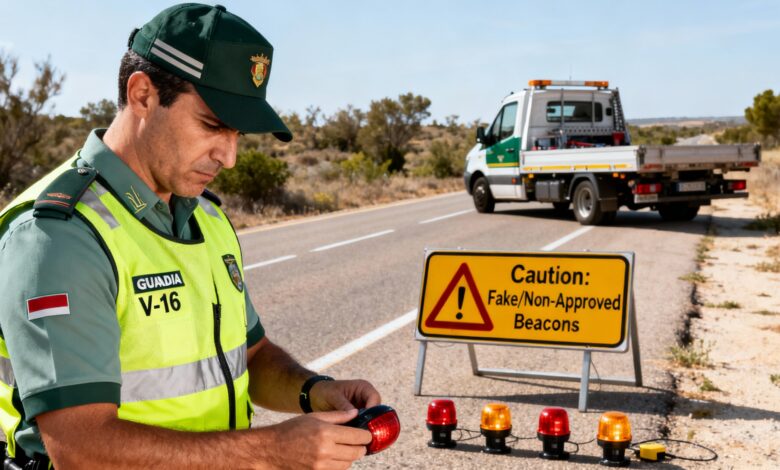
Since the beginning of 2026, Spain’s roads have undergone a true revolution: the familiar warning triangles have been replaced by modern V-16 beacons. These devices, flashing a bright orange light, are now mandatory for all vehicles in the country. Their primary purpose is to quickly and safely mark a broken-down or accident-involved vehicle—without the driver having to step onto the roadway. The progress seems obvious: less risk to life, more information for other road users.
However, new technologies have also brought new threats. In the first months after the V-16 beacons became mandatory, a wave of fraud swept across Spain. Organized groups, popularly called ‘pirate tow trucks,’ have learned to exploit the geolocation features of these devices for their own gain. They track breakdown and accident signals so they can reach the scene first and pose as official roadside assistance.
How the Scam Works
The fraud scheme is simple but highly effective. As soon as a driver activates the V-16 beacon, the traffic control system receives the coordinates of the stopped vehicle. This is exactly what the scammers take advantage of: they monitor active signals, quickly arrive at the scene, and present themselves as official service personnel. To appear convincing, they use vehicles with stickers resembling those of real tow trucks.
Drivers who find themselves in stressful situations—especially at night or on busy roads—often don’t pay attention to the details. They accept assistance without checking documents or contacting their own insurance company. As a result, their cars end up at unknown garages, and they are forced to pay hefty fees to get them back—ranging from 150 to 300 euros. Only later do they discover that these “helpers” have no connection to any official services.
Authorities respond
Spanish authorities have not remained indifferent to this new wave of fraud. Highway officials emphasize that no official tow can take place without confirmation from your insurance company. If someone demands cash payment on the spot or insists on taking your car to a specific service shop without your approval, it’s a clear sign of a scam.
Additionally, it is noted that V-16 beacons do not transmit personal data of the driver or information about the route. Location data is sent only at the moment of device activation and only while it is operating. Once it is turned off, the beacon stops sending any signals. However, even this window of time is enough for fraudsters to quickly react to the appearance of new ‘clients.’
How to avoid being scammed
To avoid becoming a victim of fraud, experts recommend following a few simple rules. After activating the V-16 beacon, be sure to contact your insurance company and wait for confirmation on who will be coming to assist you. Insurance companies usually provide the name of the firm and the tow truck number in advance. If anyone demands immediate cash payment, this is a red flag. Official services work under contract with your insurer, and all payments are handled without your involvement.
You should also be wary if the tow truck insists on taking your car to a repair shop you don’t know. Such actions are not allowed without the consent of the owner and the insurance company. Don’t hesitate to ask questions and request documents—this is your right and your safety.
Privacy Concerns
Debate continues around the privacy of the new V-16 beacons. Many are concerned that these devices could track drivers’ movements or collect personal information. However, experts assure that the beacon transmits only a technical identifier and coordinates at the moment of activation. There is no link to your name, car number, or route. Even when purchasing the device, you are not required to provide personal details, and once deactivated, the beacon completely stops transmitting information.
However, the situation with fraudsters shows that even the most advanced technologies can be used for deception if basic safety measures aren’t observed. Spanish roads are becoming safer, but scammers’ tactics are evolving too. In today’s environment, vigilance and caution remain a driver’s best allies.