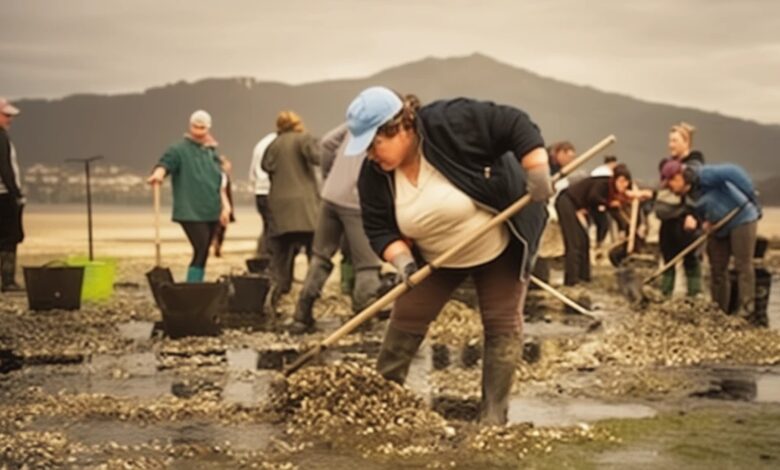
In Galicia, winter storms and continuous rains have led to an unprecedented die-off of shellfish, dealing a serious blow to the region’s economy. Hundreds of families whose livelihoods depend on shellfish harvesting now face the threat of losing their main source of income. The impact of these weather disasters is being felt not only in the fishing sector but also in related industries that rely on a steady supply of seafood.
In March, 12 tons of dead shellfish were removed from the estuary in the Noia area (Noia, A Coruña). According to local associations, up to 90% of berberecho, 95% of almeja babosa, and 60% of Japanese clam perished. This is not the first such incident: earlier in the month, another 17 tons of dead shellfish were collected. Removing the dead shellfish is essential to prevent the blockade of the population’s natural recovery, as their accumulation hinders new larvae from settling in the seabed.
Economic blow
The marisqueo sector in Galicia has been among the hardest hit by the January and February storms. An excess influx of fresh water into the estuaries sharply reduced salinity, causing mass shellfish mortality. According to EFE, losses are estimated at €8–10 million, as these grounds were particularly rich in juveniles this season. For many families, this means the loss of their only income, while for the region, it poses a threat to economic stability.
Professional associations have already appealed to the Galician government to declare force majeure and allow the processing of compensation payments for cessation of activity. Mariscadores are now awaiting official reports from Consellería do Mar to receive support. As noted by La Voz de Galicia, cleanup operations for dead shellfish will resume when the tides permit.
Problems in other regions
The situation in Noia is not the only worrying sign. In the Arousa estuary, a mass shellfish die-off has also been recorded due to heavy rainfall. According to Plataforma en Defensa da Ría de Arousa (PDRA), over the past five years, the sector has suffered economic losses totaling 59 million euros. In 2024–2025 alone, shellfish production (excluding mussels) fell by 52% compared to the 2019–2023 average, resulting in losses of almost 30 million euros.
Certain species, such as almeja babosa, Japanese, fina, rubia, and berberecho, have been particularly affected. The latter has seen its population drop by 87%. Since 2008, berberecho has shifted from being a key resource to a rarity in the region. Winter storms have only worsened the already difficult situation for mariscadores.
Impact on the region and outlook
The mass die-off of mollusks in Galicia is not only an environmental issue but also a socio-economic one. Decreased production affects prices, employment, and the region’s export potential. In recent years, similar disasters have occurred in other parts of Spain, where extreme weather events have led to reduced catches and rising unemployment among fishermen. According to russpain.com, it may take several years for mollusk populations to recover after such incidents, and the impact on local economies can last even longer.
Episodes of extreme weather in Spain are becoming increasingly frequent. In 2023, similar storms already caused the mass death of fish and mollusks in the estuaries of Cantabria and Andalucía. At that time, local authorities also had to introduce temporary fishing restrictions and provide support to those affected. Experts point out that such events require not only emergency responses but also long-term strategies for adapting to climate change and protecting the region’s traditional industries.