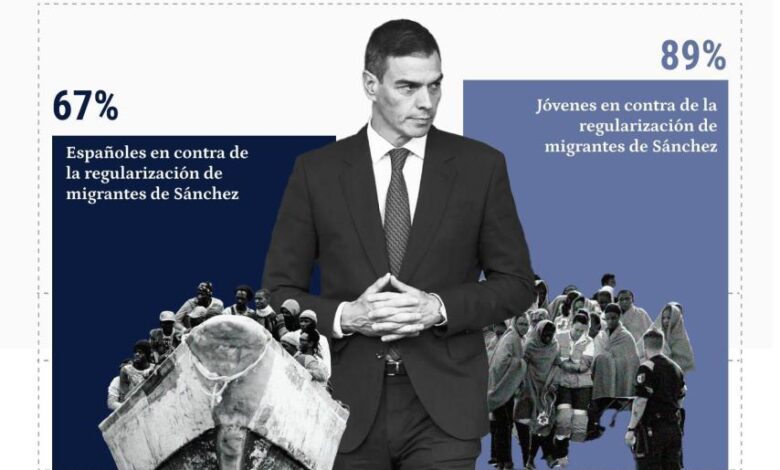
The issue of mass legalization of undocumented migrants became one of the most hotly debated topics in Spanish society in 2026. The decision by Pedro Sánchez’s government to grant residence permits to hundreds of thousands of foreigners triggered a strong reaction and sparked widespread discussion about the country’s future. For many Spaniards, the consequences of such a move seem unpredictable, and the risks—too high.
According to a recent survey, 67.4% of Spanish citizens do not support the mass legalization initiative, and among young people aged 17 to 35, this number rises to 89.3%. Support for the idea comes mainly from left-wing party supporters, such as PSOE, Sumar, and Podemos; however, even among them, one in four disagrees with the government’s actions. Meanwhile, 69% of respondents fear that such measures will create a “pull factor” and increase the flow of illegal migrants.
Society’s reaction
Most Spaniards are convinced that unless the legalization process is accompanied by strict checks, it could lead to a rise in crime. 82.6% of respondents believe that foreigners who cannot prove they have no criminal record should be deported. Young people hold particularly firm views—among them, this figure exceeds 94%. Even among left-wing voters, nearly a third fear that the new rules could allow individuals with a criminal past to legalize their status.
Skepticism is mounting amid the fact that since Sánchez came to power, the number of undocumented migrants in the country has increased eightfold. In 2008, there were around 107,000, whereas by 2025, this number will reach 840,000. It is expected that after the new law is adopted, at least half a million people will receive residence permits—and possibly even more.
Political disagreements
Domestically and at the European level, the government’s decision has drawn sharp criticism. Representatives of the European Commission and the European People’s Party stated that such steps undermine trust in the EU’s migration policy and could lead to stricter rules for all Schengen countries. Some political forces in Spain, such as Junts and PNV, have also hardened their rhetoric on migration issues, despite previous agreements with the government.
Particular discontent is caused by the fact that the current decree allows legalization even without a criminal record certificate—signing a declaration is enough. This raises concerns that the process will become a mere formality and fail to weed out potentially dangerous individuals. Many recall the experience of 2005, when the government of José Luis Rodríguez Zapatero carried out a large-scale legalization, but at that time a labor contract and proof of employment were required.
Motives and consequences
Many Spaniards suspect that there are motives beyond humanitarian considerations behind the government’s decision. 41% of respondents believe the legalization is intended to shift the electoral balance, and this view is even more prevalent among supporters of opposition parties. Around 29% are confident the goal is to restore support for left-wing parties, while 28.2% think the aim is to legalize those who are already working and integrated into society.
In light of these developments, the prospect of granting voting rights to migrants is also under discussion. Minister Irene Montero has already announced plans to amend the law so that new citizens can vote in elections. This has sparked another wave of debate about the future of the country’s political system and a possible shift in the makeup of the electorate. Similar changes have been discussed previously, and in the article on the impact of new voters on Spain’s political map the possible consequences of such reforms were explored in detail.
Context and comparisons
In recent years, Spain has repeatedly faced waves of migrant legalization, each sparking fierce public debate. The large-scale regularization of 2005 became one of the most discussed reforms, and its consequences are still debated among experts today. In other EU countries, similar initiatives often led to tougher migration laws and growing discontent among local populations. In 2023–2025, stricter entry and stay rules in the Schengen area were introduced in response to the rise in irregular migration and attempts by certain countries to simplify legalization procedures. The question of balancing compassion and security remains unresolved today.