In early 2026, Spain’s Ministry of Transport announced the launch of a major infrastructure project in one of the country’s most densely populated areas. At first glance, it may seem like just 8.3 kilometers of new road, but these figures mask a much more ambitious goal — to ease traffic on Murcia’s congested thoroughfares and give the region fresh momentum for growth.
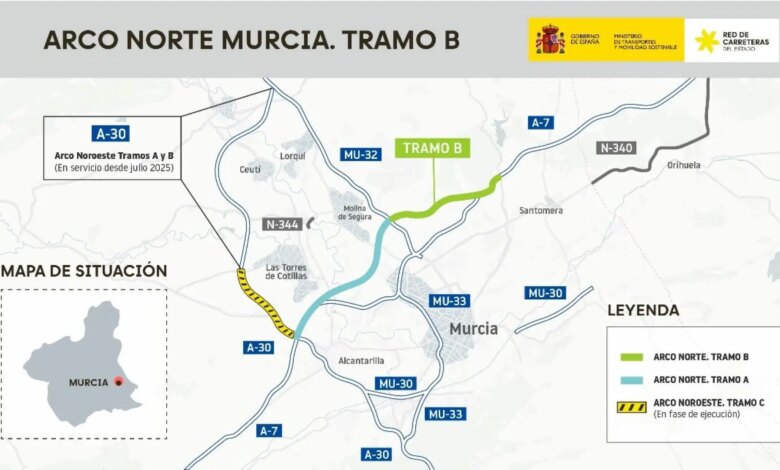
Nearly 98 million euros — that’s the funding allocated for the construction of a section that will become part of the future Arco Norte de Murcia highway. This segment will connect the 652nd kilometer of the A-7 motorway with the Cabezo de Torres interchange, already attracting considerable interest from experts and locals alike.
The ministry, headed by Óscar Puente, makes no secret of its intentions: the project is designed to provide an alternative for transit traffic, which every day is mired in gridlock on Murcia’s northern approaches. In some areas, traffic reaches 125,000 vehicles per day — and that’s not the limit.
Construction and project details
The new section, designated as ‘Trench B,’ will serve as a key component of the future bypass. Stretching 8.3 kilometers, the route will start from a new interchange at the fourth kilometer of the MU-32 and end at the A-7 near Cabezo de Torres. The project includes the construction of thirteen engineering structures: three viaducts, four overpasses, and six underpasses. This is more than just a road — it is a complex designed to handle heavy traffic loads and ensure road safety.
Preparatory work is also underway on another section — ‘Trench A.’ An announcement about the start of its construction is expected soon. The entire Arco Norte route will consist of two segments, each engineered to divert transit traffic between Andalucía and Spain’s eastern coast (Alicante and Valencia) away from the urban districts of Murcia.
Regional significance
In recent years, Murcia’s authorities have prioritized the development of transport infrastructure. Just in the past few months, work was completed on two segments of the A-30 highway, which connects Albacete and Cartagena via Murcia. These stretches have become part of the so-called Arco Nordeste, which has already eased congestion on the A-7 and improved regional logistics.
The A-30 highway now starts at the Archena interchange on the MU-32 and ends near Ceutí, with a second section reaching Las Torres de Cotillas. The total length of the new roads is nearly 14 kilometers, with project investments exceeding 169 million euros.
Transport Challenges
Murcia has long struggled with traffic congestion. Overcrowded highways, constant traffic jams and accidents have become a daily reality for both residents and visitors. The new Arco Norte is set to become a real lifeline for those stuck in kilometer-long queues entering and leaving the city every day.
The Ministry of Transport emphasizes that the main goal is to separate transit and local traffic flows. Truckers and travelers will be able to bypass Murcia on the new highway, leaving city roads freer for residents. This will not only improve safety, but also reduce travel time for all road users.
Economic Impact
Investing in road infrastructure is more than just an expense—it’s an investment in the region’s future. With the completion of Arco Norte and the modernization of adjacent highways, Murcia is expected to see new opportunities for business, tourism, and logistics. Improved transport accessibility will inevitably boost the region’s appeal for investors and major companies.
Additionally, work is already underway to improve the exit from the A-30 to the MU-30, with another 12 million euros allocated for this purpose. Together with other projects, these efforts are shaping a new transportation map for Murcia, where the priorities are safety, speed, and comfort.
The Future of Murcia’s Roads
Plans to develop the region’s transport system go far beyond Arco Norte. In the coming years, new projects are expected to launch that will finally solve the issue of road congestion and make Murcia one of the most attractive regions in Spain for living and working.
Officials openly admit: their strategy relies on a comprehensive approach. This includes new bypasses, reconstruction of existing routes, and the introduction of modern traffic management technologies. Altogether, these initiatives should help Murcia shed its reputation for never-ending traffic jams and serve as a model for other regions in the country.
RUSSPAIN reminds readers that Spain’s Ministry of Transport (Ministerio de Transportes) is the key government body responsible for developing the country’s transportation infrastructure. In recent years, under the leadership of Óscar Puente, the Ministry has actively implemented large-scale projects to modernize roads, railways, and other transport systems, focusing on innovation and sustainable development.