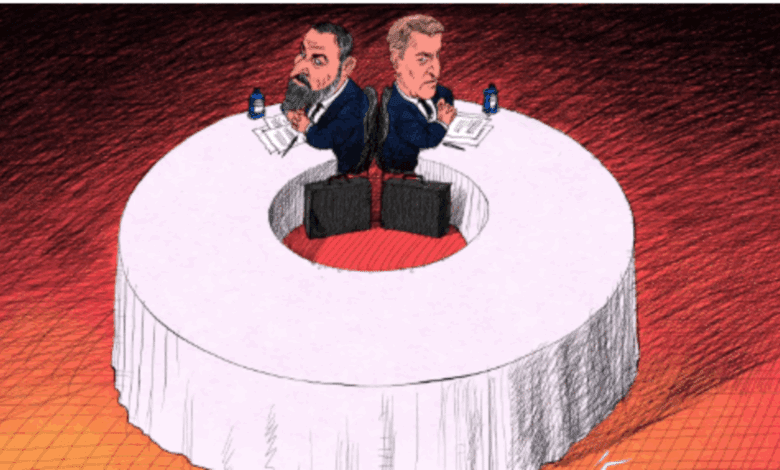
Political uncertainty is growing in Spain: negotiations between Vox and the People’s Party (PP) to form regional governments in Extremadura and Aragon have reached a stalemate. This could lead to new elections in the coming months, potentially reshaping the balance of power not only in these regions but also nationwide. For Spaniards, this signals possible changes in governance and new decisions that may impact daily life.
This week, Vox representatives are scheduled to meet with María Guardiola, but no public agreements are expected until the elections in Castilla y León conclude. According to Ale Espanol, PP believes that Vox is projecting a tough stance for the public, while behind the scenes discussions on the investiture continue. The national leadership of the PP has taken a more active role in the talks to avoid early elections in the regions.
Secret negotiations
In Génova (Génova) and the PP regional headquarters in Mérida and Zaragoza, there is confidence: no agreements with Vox will be made before the elections in Castile and León. Nevertheless, a meeting with Guardiola is already scheduled for this week, signaling movement in the negotiations, even if this is officially denied. Vox leader Santiago Abascal reacted sharply to the document offered by PP, calling it a mistake, but sources close to Guardiola insist that talks are ongoing. Expectations for the upcoming meeting are modest — no breakthrough is anticipated before the first round of voting on March 3. Guardiola’s circle believes Abascal’s statements are more of a political gesture than a true reflection of the situation.
The PP emphasizes that their document is not only for Vox, but for all potential negotiating partners, including UPN, the Canary Islands Coalition, and even Junts, as long as they act within the framework of the Constitution. This projects an image of openness, but at the same time complicates the dialogue with Vox, which insists on a special approach. In Extremadura and Aragón, negotiations are unfolding in parallel, and the PP hopes Vox shares the goal of preventing the return of leftist forces to power.
Risk of new elections
In the coming weeks, Extremadura will hold two rounds of voting for the regional leadership candidate. The first requires an absolute majority, the second a simple majority—but even that can’t be secured without Vox’s support. If no compromise is reached, a two-month countdown will begin, leading to the dissolution of parliament and new elections that could coincide with those in Andalusia. Neither PP nor Vox finds this scenario acceptable, but the likelihood is increasing.
While the clock in Mérida ticks toward possible new elections, in Aragón, acting president Jorge Azcón made an unexpected visit to PP headquarters in Madrid to discuss strategy with the party’s secretary general, Miguel Tellado. According to RUSSPAIN.COM, both sides discussed the post-election situation and coordinated steps to ensure regional stability. In the near future, PP aims to strengthen its position in talks with Vox to speed up the formation of a new government.
Strategies and confrontation
The PP’s secretary general is working to deescalate tensions, emphasizing that Guardiola and Azcón are the main negotiators. However, Vox continues to insist on its demands, rejecting the PP’s proposed document and requiring specific measures, deadlines, and guarantees. Despite this, in Extremadura the sides are close to a programmatic agreement, while in Aragón formal talks have yet to begin.
Intraparty disagreements and public statements by leaders are creating an atmosphere of uncertainty. It is important to note that this tactic has already proven effective for Vox in other regions, where the party has strengthened its position through tough rhetoric and direct engagement with voters. This was covered in detail in a feature about how Abascal’s party is gaining support in small towns— Vox’s regional strategy shows that focusing on strong principles and openly stated demands can be effective.
Context and consequences
In recent years, Spain has already faced situations where the lack of agreements between parties led to repeated elections. For example, in 2019, the country held general elections twice due to the inability to form a stable government. Similar scenarios have occurred at the regional level, where political disagreements prolonged the government formation process for months. Such events always cause concern among residents, as political decisions determine not only the composition of the government but also the future of regional programs, infrastructure funding, and social initiatives.