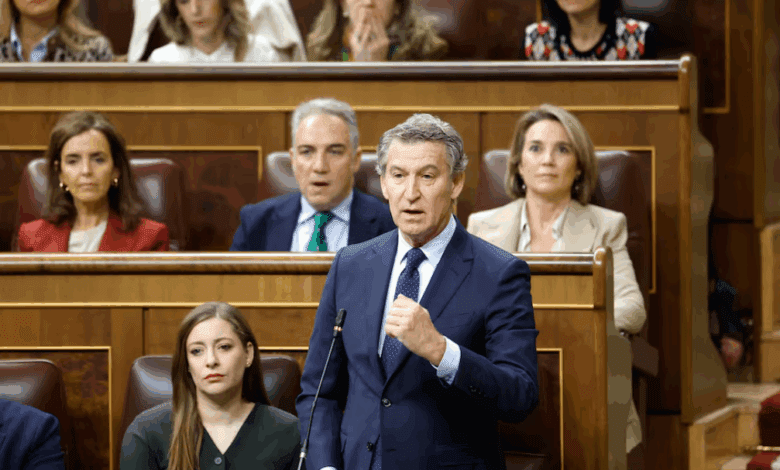
Spanish politics is once again embroiled in controversy over international conflicts, this time focusing on the Popular Party’s (Partido Popular, PP) response to events in Venezuela. Following the recent US operation to detain Nicolás Maduro and Donald Trump’s statements about taking control of the country, the PP has chosen not to issue direct statements on the matter. Instead, Feijóo’s party is once again referring the question of Washington’s actions to the courts, repeating the cautious strategy it previously used in the Gaza conflict.
In September last year, as Israel’s military operation in Gaza was being debated, the PP also avoided clear wording, choosing instead to defer to the competence of international courts. Now, when faced with the issue of a possible violation of international law by the US in Venezuela, the party once again sidesteps direct statements. PP representatives say that only a court can determine whether Trump violated international norms, refusing to take responsibility for a political assessment of the situation.
Double standards?
This approach has raised questions among parts of Spanish society and political circles. On the one hand, the PP actively criticizes the Maduro regime and demands elections in Venezuela, while on the other, it avoids condemning US actions, even when a possible breach of international law is at stake. At the same time, the party does not support the appointment of Delcy Rodríguez as interim president and continues to call for greater involvement from opposition leader María Corina Machado.
In public statements, PP representatives emphasize that Venezuela’s future should be decided through elections, but do not specify when exactly these should take place. Deputy Secretary for Finance Juan Bravo highlights that the country would be ‘better off without Maduro,’ yet he prefers to support the position of US Secretary of State Marco Rubio rather than Trump himself. Even regarding Washington’s plans for Greenland, the PP maintains a cautious stance, stressing the need to respect Denmark’s opinion.
Internal party disagreements
Interestingly, there are differing voices within the party itself. Earlier this week, Cuca Gamarra, who is responsible for institutional renewal, expressed doubts about whether the US had violated international law in Venezuela. However, two days later, the party chose not to elaborate on this issue, limiting itself to general statements about the need to honor Spain’s international commitments.
At the same time, the Foundation for Analysis and Social Studies (FAES), which is affiliated with the PP and chaired by former prime minister José María Aznar, sharply condemned Trump’s actions, accusing him of attempting to ‘colonize’ Venezuela and calling his statements ‘extremely reckless.’ However, the party itself distances itself from FAES’s position, stressing that it is an independent body.
Politics and accusations
The PP never misses a chance to accuse Pedro Sánchez’s government of using the Venezuelan crisis as a distraction from domestic issues and corruption scandals surrounding the PSOE. According to party representatives, the current Cabinet has abandoned international leadership and forgotten about the fate of Venezuela’s political prisoners.
In recent months, criticism of the Maduro regime has become a key theme in the PP’s foreign policy rhetoric. However, when it comes to US actions, the party prefers not to take a clear stance, raising questions about the consistency and principles of their approach.
Parallels with Gaza
The situation with Venezuela strongly echoes the PP’s behavior during debates over Israel’s operation in Gaza. At that time, the party also refused to give its own assessment, deferring instead to international courts. Parliamentary spokesperson Ester Muñoz stated outright that it should be judges—not politicians—who determine whether genocide is taking place.
This approach allows the PP to avoid controversy and maintain relations with key international partners. However, for voters and observers, it appears as an attempt to shirk responsibility and avoid taking a clear position on critical issues of foreign policy.