In Spain, the rivalry between the Partido Popular (PP) and Vox has flared up once again. After a brief lull due to negotiations over government formation in Valencia, both parties have returned to open competition. This time, the epicenter of the conflict is Extremadura, where regional elections are just around the corner. The region’s president, María Guardiola, has decided to call early elections in hopes of securing an absolute majority. However, recent polling data shows she is far from reaching that goal.
The PP has ramped up its campaign against Vox, accusing its rivals of actions that play into the hands of the socialists. Both parties share the goal of ousting Pedro Sánchez as prime minister, yet they are fiercely competing with each other for the votes of those opposed to the current leader.
Escalation of the conflict
PP leader Alberto Núñez Feijóo has publicly called on Vox to stop “playing both sides” with the socialists, while Vox chief Santiago Abascal responded by criticizing his opponents for a lack of resolve and unwillingness to initiate a vote of no confidence against Sánchez. Until recently, Feijóo avoided direct attacks on Vox, but with the start of the new political season, that strategy has changed: now the PP openly targets the far right.
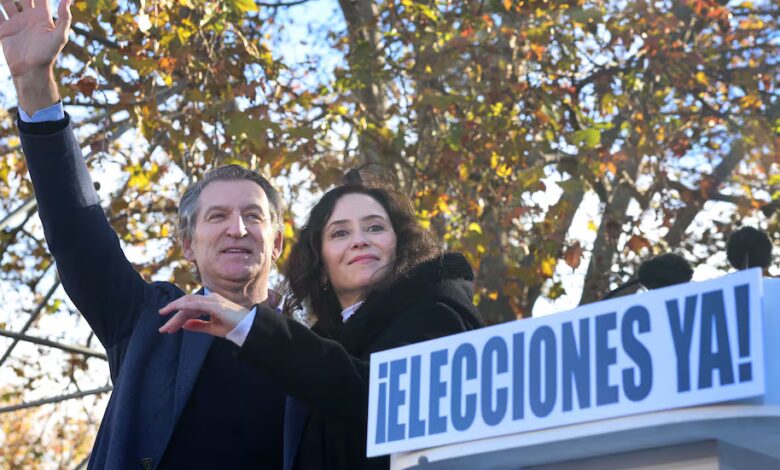
A temporary truce between the parties was reached after the resignation of Carlos Mazón, with whom Vox had good relations. However, after the situation in Valencia was resolved, the PP shifted its focus to Extremadura. Here, the party fears difficult coalition talks if Guardiola fails to secure majority support. Last Sunday, the PP gathered around 40,000 supporters in Madrid near the Templo de Debod, according to authorities.
Public accusations
During the rally, Feijóo addressed representatives of all parliamentary parties, singling out Vox. He urged them not to mistake their adversary and to end their cooperation with the Socialists. Vox refused to support the event, calling it a ‘farce,’ but party supporters still held their own demonstration outside the PSOE headquarters on Ferraz street, drawing about a thousand people.
The response was swift. Madrid President Isabel Díaz Ayuso sharply criticized Vox on social media, accusing them of trying to divert attention from the PP’s mass rally. She said that Vox acts in Sánchez’s interests even on Sundays. In response, Vox representatives accused Ayuso of insulting free citizens and reminded her that their party is the one vigorously fighting the Socialists in the courts.
Internal party tensions
The conflict between the parties continued the next day. PP deputy secretary Cuca Gamarra emphasized on national television that Vox has recently targeted the PP more than the Socialists. She urged voters seeking change to support the People’s Party, arguing that it is the only force truly capable of transforming the country.
All this is part of a new PP strategy aimed at attracting so-called ‘useful votes’ ahead of elections in Extremadura. During a rally, Feijóo openly acknowledged ongoing disagreements with Vox and called on the far-right to show maturity and avoid repeating mistakes of the past.
Extremadura — the new battleground
Vox, for its part, is actively campaigning in the region. Abascal has already held several meetings with voters in Extremadura and did not miss the chance to address Feijóo’s criticisms. He accused PP of striking deals with the Socialists and called on the party to engage in real opposition, not just hold rallies for appearances.
According to the latest polls, Guardiola has a chance at victory, but she is at least four seats short of an absolute majority. This means she will once again need the support of Vox to form a government, with forecasts suggesting the far-right could double its results compared to previous elections. Previously, Guardiola categorically rejected the possibility of a coalition with the far-right, but ultimately was forced to make concessions.
Tough rhetoric
During Sunday’s rally, after Junts rejected the motion of no confidence, Feijóo ramped up his criticism of Sánchez. He even hinted at possible criminal prosecution for former Socialist ministers who are under investigation. Miguel Tellado, PP’s number two, stated that the party would summon one of the key figures in the Koldo case to testify in the Senate.
Thus, the political battle on the right flank of Spanish politics is reaching a new level. The PP and Vox continue to exchange accusations and reproaches, both vying to win over voters dissatisfied with Sánchez’s policies. Extremadura has become the main battleground where it will be decided which of them can become a real alternative to the current government.