Debate continues in Spain over how Queen Letizia fulfills her role as a moral support for those affected by disasters. Her presence at sites recently struck by natural calamities or tragic accidents always attracts significant attention and anticipation. Letizia doesn’t just show up—she listens, empathizes, and for many, becomes a symbol of support during their darkest hours.
In recent years, Spain has faced a series of disasters, each leaving a profound mark on thousands of families. The Queen and King Felipe have repeatedly traveled to affected regions to meet victims and their loved ones in person. In Adamuz, site of a devastating train accident, Letizia once again demonstrated remarkable composure. Not for a second did she allow herself to turn away from others’ grief, emphasizing: “We have no right to look away from tragedy.”
The families of the deceased and injured say the royal couple’s attention was anything but formal. Rescue workers, volunteers, and local residents worked side by side, and the monarchs did not remain on the sidelines. At a hospital in Córdoba, King Felipe stressed that a country is defined by how it responds to emergencies and by how protected its people feel.
Trials and emotions
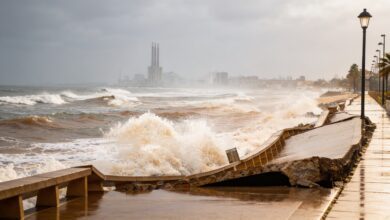
Each new tragedy becomes a personal test for Queen Letizia. Unlike the king, who often takes on the role of organizer and peacemaker, Letizia confronts emotional strain head-on. In Paiporta, where the aftermath of the flood was particularly devastating, she was not afraid to be at the very heart of the events. People who had lost everything literally clung to her, seeking even the slightest comfort.
That visit was remembered not just for images of the queen leaving the disaster zone covered in mud, but for how she withstood the emotional onslaught. People all around were crying and shouting—some tried to hug her, others simply stood in silent despair. Letizia didn’t lose her composure, even though the tension was overwhelming. In such moments, it becomes clear: even the strongest personalities are not immune to emotional scars.
Fires in Galicia, León, and Extremadura, devastating floods in Valencia—each time, the queen found herself at the epicenter of human suffering. After the disaster in Valencia that claimed hundreds of lives, Letizia became, for many, a symbol of compassion and hope. Her ability to listen and empathize has often diffused tense situations when emotions threatened to spiral out of control.
The Face of the Monarchy
In recent years, the approach to organizing royal visits to disaster zones has changed. While meetings with victims used to take place in front of the entire country, they now often happen in a more private setting. In Adamus, the queen and king chose to meet families of the victims away from the cameras, so as not to turn someone else’s grief into a public spectacle.
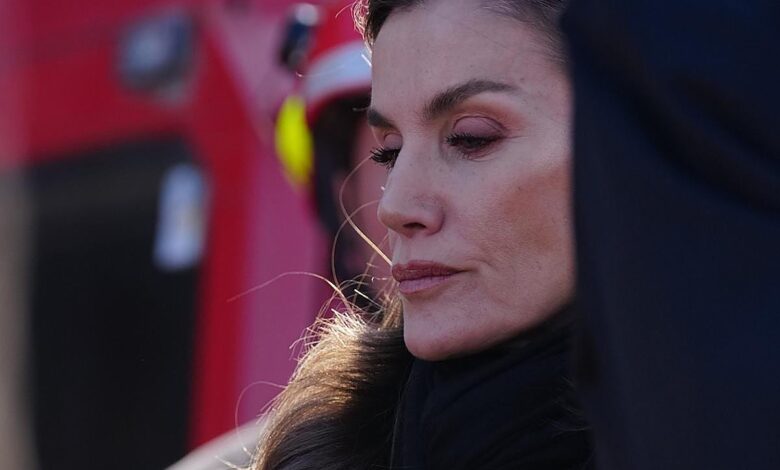
Still, one thing remains unchanged: Letizia is always the most approachable figure for those affected by tragedy. Her serious, sometimes somber gaze speaks louder than words. She does not hide her exhaustion or concern, and this sincerity is exactly what earns people’s trust. For many, she is not just a royal, but someone who can truly understand and share their pain.
Not every visit leaves an indelible mark on the queen, but each time she faces stories she cannot forget. There is not a trace of insincerity in her actions—only genuine care and the desire to help. Spaniards see her as not only a monarch, but also a woman who is able to empathize and offer support in the most difficult moments.
The weight of the mission
With each new disaster, Queen Letizia takes on more and more emotional burden. Her role is to be present when words fall short, and to simply listen when there is no consolation. In these moments, she becomes for the victims not just a symbol, but a true human being who is not afraid to share in their grief.
There is a growing discussion in society about how such meetings impact the psychological well-being of monarchs. Even the strongest individuals can’t remain indifferent to the suffering of others. Despite her outward composure, Letizia has repeatedly shown that she cares deeply about what happens around her. Her participation is not just a formality, but a conscious choice.
Perhaps it is this sincerity that makes Queen Letizia one of the most respected figures in modern Spain. She is not afraid to show vulnerability, doesn’t hide her emotions, and is always ready to support those on the brink of despair. For many, her presence is a sign that the country does not forget its citizens, even in the darkest times.