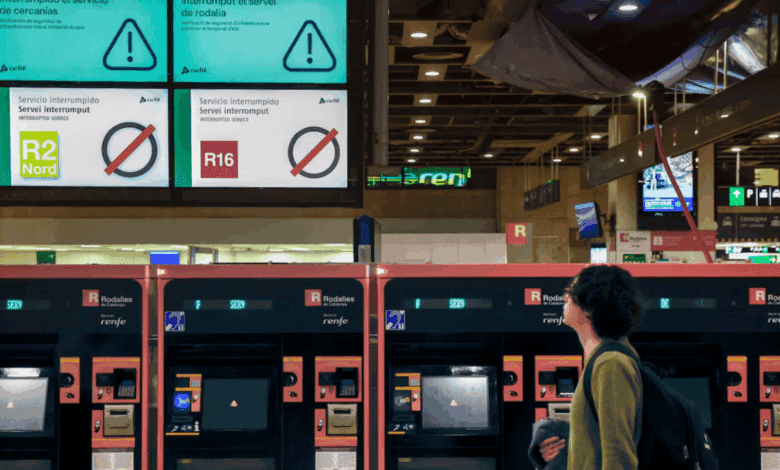
Residents of Catalonia are once again experiencing major disruptions on railway routes: Renfe has resumed train services, but nearly 200 sections of the network are operating under strict speed restrictions. The reason is ongoing maintenance and safety checks being carried out by Adif. On some routes, trains have been replaced by buses, causing further inconvenience for passengers and disrupting the region’s usual rhythm of life.
The situation is particularly acute on Rodalies lines, where speed restrictions and temporary routes have become the new reality for thousands of people. Authorities in Catalonia and Spain assure that most restrictions will be lifted by late February or early March, and by April, Rodalies is expected to return to normal operations without enforced slowdowns. In the meantime, passengers must cope with delays and transfers, as well as keep a close watch on schedule changes.
Restrictions and alternatives
On the R1 line between L’Hospitalet de Llobregat and Blanes, trains are running on schedule, but the section from Blanes to Maçanet-Massanes is served by a special shuttle train every hour and a half, and is also covered by bus services. On R2 Sud, two trains per hour run in each direction, with all trains stopping at every station between Sant Vicenç de Calders (Tarragona) and the terminal stations.
The R2 and R2 Nord lines continue to operate along their entire routes, but service on the R3 line is fully suspended due to construction work. Passengers have to transfer to R4 trains between L’Hospitalet and Fabra i Puig (Barcelona), then take buses to La Garriga, Centelles, or Vic. The Centelles/Vic to Puigcerdà section is also served by buses with intermediate stops.
Trains on the R4 run between Sant Vicenç de Calders and Sant Sadurní d’Anoia, after which buses transport passengers to Martorell Central every 30 minutes. From Martorell Central to Terrassa Estació del Nord, trains are available again, and on the section to Manresa, a special shuttle train operates once an hour, supported by additional bus service.
Prolonged disruptions and new failures
The R7 line will remain closed until May, and on the Barcelona Fabra i Puig — Cerdanyola del Vallés section, passengers can use R4 trains, while buses connect Cerdanyola del Vallès with the UAB Eix Sud university campus. The R8 is also not operating, with buses running between Martorell Central and Granollers Centre making stops along the way, and on the Granollers Centre — Mollet-Sant Fost route, it is possible to transfer to R2 Nord trains.
Yesterday, new problems emerged on the RL4 line between Manresa (Barcelona) and Cervera (Lleida): the section between Cervera and Calaf was closed after drivers detected possible faults. Although a full restoration of service had been announced earlier, passengers are once again being transferred to buses. According to Silvia Paneque, Minister for Territory, Housing and Ecological Transition, the section will remain closed until safety is confirmed by Adif and Renfe.
Regional impact
Widespread disruptions in the rail network have already sparked a wave of discontent among residents and businesses. Many passengers complain about long waits, transfers, and a lack of clear schedule information. Authorities emphasize that all measures are being taken for safety reasons, but for many Catalans, this is little consolation amid the daily inconveniences.
The railway situation in Catalonia is nothing new: the region has previously faced major breakdowns and service suspensions. For example, the freight transport crisis in Barcelona led to significant economic losses and growing dissatisfaction among entrepreneurs. Such incidents highlight the vulnerability of the transport system and the urgent need for infrastructure investment.
In recent years, Spain’s rail network has repeatedly come under fire for frequent accidents, technical failures, and delays. Large-scale strikes by train drivers come to mind, which brought traffic to a standstill across the country, as well as accidents on key routes that led to mass train cancellations. Each such incident is a challenge for passengers and a test of resilience for the entire national transport system.