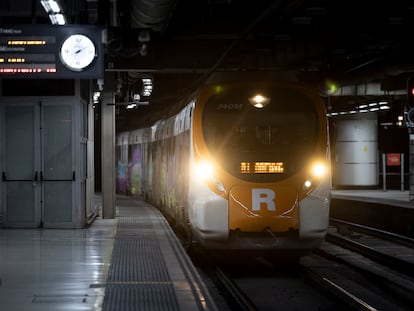
Hundreds of thousands of passengers in Catalonia have once again found themselves stranded amid a transport collapse. After the tragic railway incident in January, which claimed the life of a train driver near Gelida (Gelida), restoring service has proven impossible. The Rodalies infrastructure is facing serious problems, and the situation will not improve in the coming days: trains will run with restrictions, and some routes will be replaced by buses.
Authorities and railway operators tried to restore the usual routine, but the extent of the damage proved too great. On many stretches of the network, trains are forced to slow down, and some segments are completely closed. For 400,000 daily users, this means more delays, transfers, and uncertainty.
Difficulties on the lines
The Minister of Transport admitted that the quality of Rodalies service leaves much to be desired. In recent days, there has been almost no improvement. At the end of January, trains were running intermittently, and on eleven sections, passengers had to transfer to buses. The first week of February will bring no relief — restrictions remain in place.
Some lines will remain closed. For example, the R8, which connects Martorell and Granollers, will not resume service due to work in the Rubí tunnel. This section is critically important for freight traffic between Spain and France, but its restoration will take weeks.
On the R1 line, which runs along the coast, service remains interrupted between Blanes and Maçanet. Work to stabilize the ground after January’s landslide is still ongoing. Passengers have to use buses on this stretch.
Uncertainty and repairs
Regional routes in Girona are facing challenges as well: between Figueres and Portbou, trains have been replaced by buses. The R2 line connecting Tarragona, Barcelona, and Maçanet is still operating as normal, but the situation may change.
Particular concern surrounds the R3 line linking L’Hospitalet de Llobregat and Puigcerdà. Major reconstruction work has been underway here for several months, with part of the route closed until May 2026. Recently, a decision was made to completely halt traffic on the hazardous section between Vic and Puigcerdà. The remaining operational stretch passes through the Pyrenees, but conditions are unstable there too: no snow removal equipment is available, and the timeline for resuming service is uncertain.
Aftermath of the accident
On the R4 line, where the tragedy occurred in Gelida, service is still interrupted between Sant Sadurní and Martorell Central. Passengers transfer to buses at this section. From Martorell Central to Terrassa, trains are running, but to reach Manresa, another bus transfer is required.
The restrictions have also affected regional routes between Manresa and Cervera, as well as between Reus and Riba Roja d’Ebre and Reus and Vinaixa in Tarragona. To compensate for the shortage of transport, authorities have increased the number of buses to 230, some of which have been brought in from other regions, including Mallorca.
Transport adaptation
Passengers are being forced to adjust their routes, spending more time on the road and facing additional inconveniences. In some cases, alternative buses cannot cope with the number of people, resulting in overcrowding and delays. For many residents of suburbs and small towns, this means disruptions to their usual routines and extra expenses.
Authorities promise to speed up restoration work, but deadlines remain uncertain. Each new failure or delay sparks a wave of discontent among passengers, and the region’s transport system is under severe strain.
In recent years, Catalonia’s railway network has repeatedly faced accidents, landslides, and technical failures. In 2023, a similar situation arose after heavy rains, when several lines were closed for weeks. Then, as now, passengers had to switch to buses and seek alternative routes. Infrastructure issues and a lack of investment remain chronic, and each new incident only intensifies residents’ frustration.