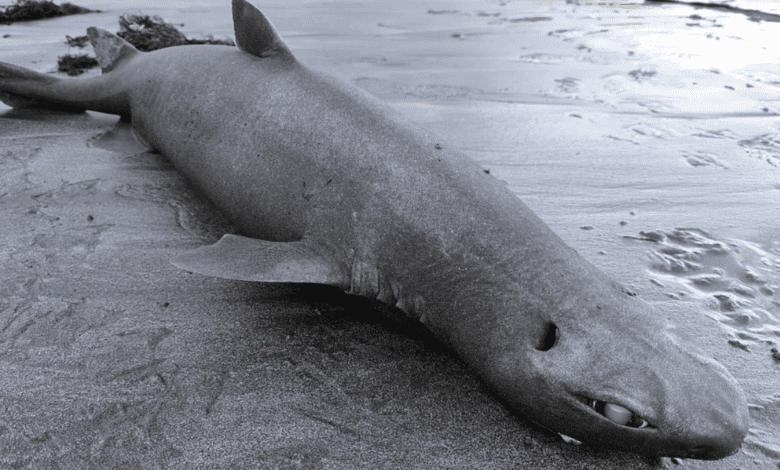
A scene worthy of a science thriller unfolded on Luarca beach in Asturias: a rare deep-sea creature known as the Portuguese dogfish (Centroscymnus coelolepis) washed up on the sand. This specimen measured 1.45 meters in length and weighed 18 kilograms. While the discovery shocked locals and passersby, for specialists it became an event that could redefine our understanding of life in the dark layers of the Atlantic.
The reason for this unusual visitor appearing in shallow water turned out to be less mysterious than its appearance. According to experts, the shark had been weakened by a serious injury: a bleeding wound, most likely from a fishing hook, was found on its body. Although the animal managed to break free, the injury caused internal bleeding and ultimately death. However, this tragic incident allowed scientists to study this rare species in detail for the first time in many years.
Depths and mysteries
Centroscymnus coelolepis is a creature about which surprisingly little is known. Typically, these sharks inhabit depths of up to 4,000 meters, a world of perpetual darkness and pressures that can crush most marine life. Even the most skilled researchers rarely venture into such places. Visually, the shark looks formidable: a massive, almost cylindrical body, dark skin, a flat belly, and a large head marked by distinctive spiracles—openings that let it draw in water for breathing without opening its mouth. Thanks to this adaptation, it can lie for hours on the seabed, conserving energy and hardly moving.
Of particular interest was the fact that the specimen found turned out to be pregnant. During the dissection, specialists discovered twelve large eggs inside, each about seven centimeters in diameter. This species is characterized by ovoviviparous reproduction: the eggs develop inside the mother, and the young are born fully formed. Such a mechanism allows the offspring to survive in the extreme conditions of the ocean depths, where danger lurks at every turn.
A scientific sensation
The autopsy performed by a team of biologists became a real sensation for the scientific community. Inside the shark, they discovered not only developing embryos but also an enormous liver—almost a third of the animal’s body mass. This organ is vital for deep-sea predators: it stores fats and provides buoyancy, enabling the creature to balance between water layers. Such findings are extremely rare, since most representatives of this species die at depths inaccessible to humans.
The incident attracted the attention of not only Spanish but also international scientists. Questions about the causes of death, reproductive characteristics, and physiology of Centroscymnus coelolepis are being discussed at international conferences. The shark’s unusual appearance, size, and internal structure have become the focus of careful study. For many researchers, this presents a unique opportunity to gather data on life in the most inaccessible corners of the ocean.
Life after death
After all examinations were completed, the shark’s body, its liver, and the found eggs were transferred to the local scientific and educational center, Parque de la Vida in Luarca. Here, anyone interested can see this rare deep-sea inhabitant and learn more about the secrets hidden by the Atlantic. The exhibition is expected to become one of the region’s most popular attractions, as such discoveries occur only once a decade.
The incident with the shark washed ashore is another reminder of the fragility of marine ecosystems and how little we know about life beneath the waves. Each such event is not just a scientific sensation but an opportunity to reflect on human impact on the ocean and its inhabitants. And perhaps encounters with the unknown like this one will inspire new discoveries and a more responsible attitude toward the sea.