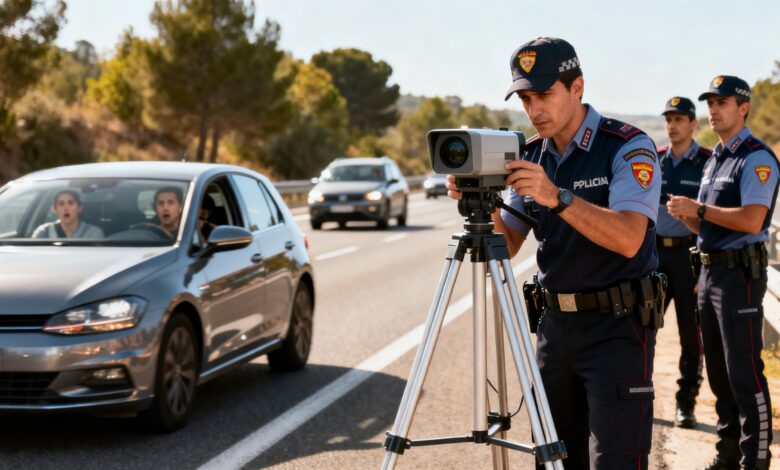
In recent years, Spain has faced a new phenomenon: the widespread sharing of exact coordinates for mobile speed cameras and police checkpoints via messaging apps and social networks. This trend becomes especially relevant during peak travel periods, such as Semana Santa, when millions of Spaniards hit the road. As a result, the habit of sharing such information has not only grown popular but also sparked serious concerns among authorities.
On the one hand, many drivers see these messages as a way to avoid fines for speeding or other violations. However, according to RUSSPAIN.COM, this practice directly impacts the effectiveness of traffic enforcement and can pose risks to road safety. It’s important to understand that not all information about controls is equally harmless from a legal standpoint.
Where is the line drawn
Fixed speed cameras in Spain are always marked on highways, and their locations are officially published by the Dirección General de Tráfico (DGT). Sharing this data does not raise concerns among law enforcement. It’s a different story with mobile speed cameras and surprise checkpoints: their precise locations are not disclosed to maintain an element of surprise and improve discipline on the roads.
In recent months, the DGT and Guardia Civil have repeatedly emphasized that publishing real-time information about mobile checkpoints may lead offenders to change their behavior only in specific areas, while continuing dangerous maneuvers elsewhere. This not only reduces the effectiveness of enforcement but also helps those driving under the influence, without insurance, or committing other serious violations evade responsibility.
Fines for sharing information
For the first time in Spain, actual sanctions for disseminating information about mobile checks were applied in Galicia. As reported by RUSSPAIN.COM, investigations uncovered WhatsApp groups with tens of thousands of members regularly sharing the exact locations of patrols. As a result, both individuals and a company managing a specialized data-sharing app were fined.
The reason for the penalties was not the traffic law, but Article 36.23 of the Citizen Security Law. This prohibits publishing information that could compromise the success of police operations or the safety of officers. In Galicia, authorities ruled that widespread dissemination of checkpoint locations undermined police work and helped offenders avoid accountability.
Implications for drivers
Penalties for such actions can be quite significant. In one instance, the administrator of a group from A Coruña, where mobile police checks along the Costa da Morte coast were discussed, was fined a substantial amount. Similar measures were taken against the company operating an app for sharing this kind of information. These precedents have served as a warning to anyone accustomed to sharing such details without considering the consequences.
At the same time, publishing information about fixed speed cameras is still permitted. DGT even encourages sharing information about such devices, considering it an additional measure to prevent violations. However, when it comes to mobile checkpoints and real-time inspections, the situation changes dramatically.
Context and new trends
In recent years, Spain has seen a rise in cases where publishing information about police activities leads to administrative actions. This is especially common during periods of heavy travel, when road controls are intensified. In 2025, authorities invested nearly one million euros in new mobile speed cameras capable of detecting violations across multiple lanes. This move responded to drivers’ attempts to evade checks by exchanging information in chat groups.
At the same time, other regions of the country are also recording cases of groups and channels being blocked for sharing information about mobile police checks. Authorities emphasize that such actions not only hinder police work but may also pose a threat to the lives and health of road users. As a result, the issue of responsibility for publishing this kind of data remains one of the most widely debated topics among Spanish motorists.
In recent years, similar cases have been reported in Europe and Latin America, where disseminating information about police checks has led to fines and the blocking of online groups. Some countries have introduced special laws restricting the publication of data on mobile patrols. In Spain, this trend is only gaining momentum, and authorities continue to seek a balance between the right to information and the need to ensure road safety.