Pedro Sánchez’s decision to oppose the US and Israeli military operation came as an unexpected move, immediately impacting Spain’s political climate. For many in the country, this action signifies not just a shift in foreign policy but also an attempt to restore confidence in the left amid mounting pressure from right-wing parties. At a time when inflation and economic hardship are troubling Spaniards, concerns over the war’s domestic consequences have become especially acute.
As reported by El Pais, following the news of Tehran’s bombing and the death of Ali Khamenei, Sánchez quickly clarified Spain’s stance: a categorical refusal to support military actions. His statement stood out against the cautious or silent responses from other European leaders, placing Spain at the forefront of the international stage. In the days after the attack, opposition parties—particularly the Partido Popular—criticized Sánchez for isolation and alleged detachment from European allies. However, by the week’s end, even politicians like Giorgia Meloni had shifted their rhetoric, and the Italian press featured the headline “Sánchez: no alla guerra” on their front pages.
Impact on Europe
Sánchez’s position quickly resonated not only among Spanish voters, but also in other EU countries. Italy’s defense minister openly expressed dissatisfaction that the Spanish prime minister had become the symbol of the anti-war movement, despite similar decisions made by other countries. Meanwhile, according to polls, support for military action in Europe has dropped sharply, and discontent with the actions of the US and Donald Trump has become noticeable even within American society. Some Arab states have refused to provide airspace for American aircraft, increasing pressure on Washington.
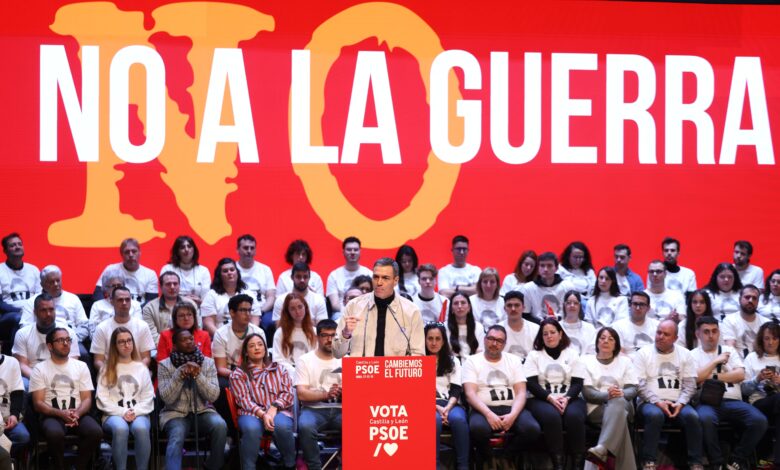
In Spain, the issue of war has become central to the PSOE’s election campaign in Castile and León. Sánchez focused on the economic risks: rising prices, inflation, and potential challenges for business and agriculture. He emphasized that the consequences of the conflict would directly affect the daily lives of Spaniards, while the opposition offered no real solutions to protect citizens from rising costs.
Opposition reaction
Despite initial support for the operation in Tehran, Partido Popular soon shifted its rhetoric, declaring that no one in Spain supports war. However, some members of the party continued to advocate for tough measures against Iran. At the same time, ministers in the Sánchez government increasingly felt that an anti-war stance allowed them to reconnect with those who opposed the war in Iraq in 2003. According to some cabinet members, the opposition is unable to effectively counter this trend, despite backing from economic and judicial circles.
Partido Popular believes that foreign policy issues will not significantly affect the outcome of the upcoming elections. In their view, voters will focus on domestic concerns, and the slogan ‘no to war’ is unlikely to change the balance of power. Nevertheless, the situation is reminiscent of events surrounding the Gaza conflict last autumn, when the government also managed to seize the initiative from the opposition.
The possibility of early elections
The debate over the likelihood of early elections reignited following Sánchez’s anti-war statements. Some political analysts suggest that if support for the left grows significantly, the prime minister could combine the regional elections in Andalusia and Catalonia with the national vote. However, sources in La Moncloa and PSOE emphasize that there are currently no grounds for such a step: the government intends to serve out its current term, and any changes are only possible if there is a clear shift in public sentiment.
Meanwhile, as El Pais reports, Sánchez’s team is confident in the soundness of their chosen strategy. According to them, their success is not a matter of chance, but the result of experience, political courage, and the ability to anticipate developments. Even before the attack in Tehran, La Moncloa had considered such a scenario and prepared possible responses. After the incident, the prime minister held talks with key European and Arab leaders, as well as with Emmanuel Macron, which helped strengthen the anti-war coalition.
Context and consequences
The surge in anti-war sentiment in Spain recalls the events of 2003, when mass protests against the Iraq war united millions of citizens. Then, as now, the question of the country’s involvement in international conflicts became a key issue on the political agenda. According to RUSSPAIN.COM, a similar situation was observed last year, when after the escalation in Gaza the government sharply increased diplomatic activity and called for an immediate ceasefire. Read more about Madrid’s response to military threats and diplomatic demands in the article on the government’s actions after the attack on Turkey. Such crises always lead to a reassessment of Spain’s role in international politics and spark public discussions about the country’s future.