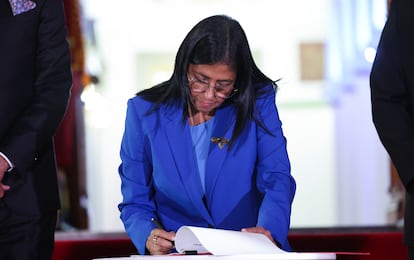
The Spanish government has unexpectedly launched a process to lift the European Union sanctions against Venezuela’s interim head Delcy Rodríguez. This move follows Venezuela’s approval of an amnesty law for political prisoners, a decision that could affect thousands of families and shift the dynamics between Spain and Latin America. For Madrid, it means not only an attempt to strengthen dialogue with Caracas, but also an opportunity to repatriate many Venezuelans who were forced to leave their country due to political persecution.
Spain’s stance
Spanish Foreign Minister José Manuel Albares announced his intention to officially request that the EU remove Delcy Rodríguez from the sanctions list. According to him, the Venezuelan parliament’s approval of the amnesty served as a signal to Europe that a new phase has begun. Albares emphasized that sanctions should be a tool to encourage peaceful dialogue, not a permanent measure of pressure. He also called on Venezuelan authorities to create conditions for the return of citizens who were forced to emigrate.
Spain is expected to officially raise this issue at the next EU Foreign Affairs Council meeting. While including the topic on the agenda does not guarantee immediate discussion or voting, Albares hopes to present arguments to his European colleagues in favor of lifting the restrictions. According to El Pais, the minister plans to give a detailed account of the situation in Caracas and explain why ending the sanctions could encourage further reforms.
Context and consequences
The Venezuelan National Assembly unanimously approved an amnesty law for political prisoners convicted of participating in protests and other events from 1999 to 2026. In Spain, this step was seen as a positive signal that could change the atmosphere in relations between the EU and Venezuela. Albares noted that previously the European Union had not imposed sanctions on Nicolas Maduro in order to keep negotiation channels open. Now, according to Spanish officials, it is time to reconsider the restrictions, including those against Rodriguez.
A key development was that Delcy Rodriguez assumed the role of interim president after Maduro was detained in the United States, where he is being held on charges of drug trafficking and other crimes. This situation has increased European interest in Venezuela’s internal affairs and prompted Spain to take a more active stance.
Reactions and comparisons
Madrid’s decision has sparked lively debate among European diplomats. Some experts believe that lifting sanctions may set a precedent for other countries where political reforms are accompanied by international pressure. In Spain, this move is seen as an attempt to restore trust in diplomatic tools and demonstrate that change is possible even in the most challenging situations.
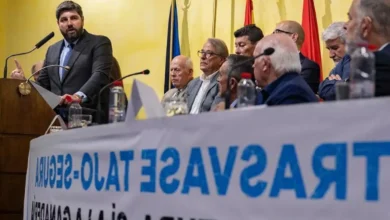
In light of recent developments in Spain, it is worth recalling how the authorities in Valencia recently tightened measures against street campaigns, sparking debates on freedom of expression. More details on the conflict between the city hall and opposition forces can be found in the article on fines for street protests in Valencia.
Background and similar cases
In recent years, the European Union has repeatedly revised its sanctions lists against Latin American countries, responding to political reforms and legislative changes. For example, following the release of several prisoners in Bolivia and Colombia, the EU also eased restrictions to support dialogue and reforms. Such decisions often provoke disputes within European institutions, but in the long run they help stabilize the situation in the region. For Spain, these steps are important not only in terms of foreign policy but also for protecting the interests of Spanish citizens and businesses in Latin America.