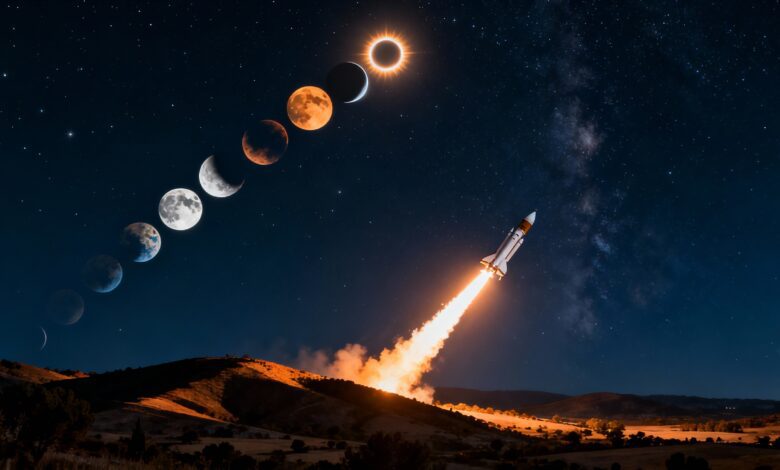
In recent months, there’s a growing sense that Spain is on the threshold of truly major space events. The year 2026 promises not just to be eventful, but historic. For the first time in over a century, the country’s residents will be able to witness a total solar eclipse—a rare astronomical phenomenon that has long surpassed science and is now perceived as an event of almost cultural significance.
The Moon’s shadow will cross Spain from northwest to southeast. The eclipse will be visible in Galicia, Asturias, Castilla y León, Cantabria, Madrid, País Vasco, Navarra, La Rioja, Castilla-La Mancha, Aragón, Valencia, Cataluña, and the Balearic Islands. Cities like León, Oviedo, Bilbao, Zaragoza, Valencia, and Palma are expected to offer a unique atmosphere—these places will have some of the best viewing conditions. Many plan to watch the spectacle from high vantage points, hoping to catch every moment.
Solar shadow
A distinctive feature of this eclipse is its timing. The total phase will coincide with sunset, when the Sun is low on the horizon. The light will gradually fade, plunging the world into twilight for a few moments. In certain areas of Castilla y León and southern Aragón, the total phase will last up to one minute and forty seconds—nearly a record for Europe.
Madrid and Barcelona won’t experience the total phase, but the Moon will cover more than 90% of the Sun’s disk, promising a breathtaking spectacle. And the 2026 eclipse is just the beginning: in 2027, Spain will see another total eclipse, followed by an annular eclipse in 2028. The country is steadily becoming a top destination for astronomy enthusiasts.
Celestial event calendar
The astronomical year won’t end with the eclipse. January will bring the Quadrantid meteor shower, though the Moon may interfere. In May, a rare “Blue Moon” will appear; June will feature a “Black Moon,” and on December 24, the largest Supermoon of the year will occur. Nearly every month of 2026 will be marked by a significant celestial event.
Planets will also be in the spotlight: Jupiter will be in opposition in January, Saturn in October, and Uranus in November. February will offer a rare conjunction of Saturn and Neptune—an alignment that hardly ever happens. Spring is expected to bring the passage of comet C/2025 R3, while the Perseids in August are forecast to be especially brilliant.
Spanish space sector
The year 2026 will mark a milestone for Spain’s space industry. For the first time, the country is planning to launch its own Miura 5 orbital rocket. The project by PLD Space, based in Elche, is gearing up for a maiden flight from French Guiana’s spaceport. This isn’t just about a launch—it’s about Spain joining the ranks of active participants in Europe’s space market. Miura 5 will be able to put satellites into orbit for both national needs and international clients.
Meanwhile, engineer Pablo Álvarez Fernández, a native of León, is preparing for his first flight into space. He has already completed basic training in Cologne and could eventually join a mission to the International Space Station. Figures like him are increasingly becoming the face of a new era for Spanish science and technology.
Connectivity and the Moon
Another major milestone will be the commissioning of the SpainSat NG satellites, which will provide secure communications for the Spanish armed forces, the European Union, NATO, and their allies. For the country, this is not only a technological step but a strategic one — it’s about independence and security, especially as the Xtar-EUR satellite is retired.
Finally, the Artemis II mission is scheduled for 2026. NASA will send four astronauts from the US and Canada to the Moon. This will be the first crewed flight of the Orion spacecraft around the Moon and is intended to pave the way for future expeditions — first to the Moon’s south pole, then to Mars. The entire world will be watching this mission, and Spain will be closely following it as well.