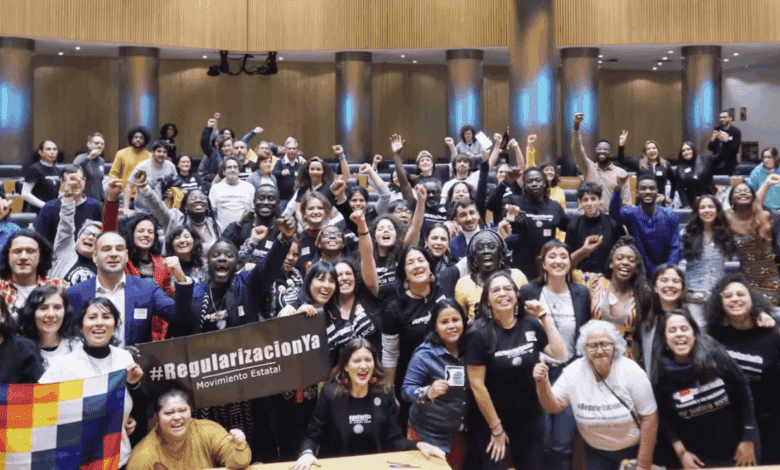
The issue of migrant legalization has once again come to the forefront of Spanish society. The government’s decision to initiate another large-scale amnesty for foreigners living in the country without documents could affect the fate of hundreds of thousands of people and impact the economy, labor market, and social stability. For many Spaniards, this is more than just a bureaucratic step—it’s a matter concerning the future of entire families, competition for jobs, and changes to the familiar way of life.
The proposal, agreed upon between PSOE and Sumar, provides for the launch of an emergency legalization process to be enacted through a special royal decree. Notably, its approval will not require parliamentary consent, a point that has already sparked criticism from the opposition and parts of the public. Preliminary estimates suggest that around half a million people could benefit from the new policy, provided they can prove they arrived in Spain before the end of 2025, have no serious convictions, and have resided in the country for at least five months at the time of application.
Historical background
Such measures are not new for Spain. Over the past decades, several governments have resorted to emergency actions to legalize migrants, each time sparking heated debate and mixed reactions from society. In 1986, four years after coming to power, the cabinet of Felipe González initiated the first mass legalization. Back then, after the adoption of a new law on the rights and freedoms of foreigners, everyone residing in the country without sufficient documentation was given a chance to obtain legal status—provided they had no serious legal violations and could demonstrate means of subsistence.
Foreign nationals had three months to submit the required documents, although the deadline was later extended. As a result, nearly 40,000 people obtained legal status through this process. By 1991, the González government once again opened the door for those working in Spain illegally, allowing them to apply for work and residence permits. The criteria included having stable employment or running a business, as well as the possibility to legalize family members who were undocumented. Over two years, more than 100,000 people took advantage of this opportunity.
Turning points
With the rise to power of José María Aznar in 1996, another legalization phase was launched, this time with stricter requirements. Only those who were in Spain before the beginning of the year and already had a work or residency permit could apply for the new status. During this period, about 21,000 people obtained documents, and in the following years, more than half a million benefited from additional measures enacted in 2000 and 2001.
Less than a year after the change of government in 2004, the administration of José Luis Rodríguez Zapatero once again returned to the practice of mass legalization. In 2005, a special decree allowed more than 570,000 foreigners to obtain work and residency permits. Employers had three months to process documents for employees who had lived in the country for at least six months. Contracts were signed on the condition that they would only take effect after the permits were granted.
Current challenges
The current government initiative raises as many questions as the previous ones. On one hand, supporters of legalization argue that it will help bring a large segment of the economy out of the shadows, increase tax revenue, and protect the rights of vulnerable groups. On the other hand, opponents fear that a mass amnesty could trigger a new influx of undocumented migrants, increase pressure on social services, and fuel discontent among the local population.
Particular attention is being paid to the fact that the decision is being made without parliamentary debate, which is seen as an attempt to bypass democratic procedures. Concerns have already been voiced in society that such measures could spark new political conflicts and even protests. However, previous years have shown that, despite the disputes, each wave of legalization has left a prominent mark on the country’s history and reshaped its demographic and economic landscape.
A look into the future
While details of the new process remain unclear, experts and civic organizations are closely monitoring developments. The question of exactly how the next amnesty will be implemented, which categories of migrants will be able to take advantage of it, and how this will affect the labor market remains open. One thing is clear: Spain once again faces a difficult choice that will shape not only the fate of hundreds of thousands of people but also the future of the entire country.