Deep within the Valencian Community, far from bustling beaches and tourist hotspots, lies one of the most remarkable feats of Roman engineering in Spain. This millennia-old infrastructure impresses with its size, meticulously planned route, and seamless integration into the rugged natural landscape. While most travelers tend to associate such monuments with other regions, it is Valencian soil that houses an aqueduct rightfully considered the largest in the country.
This is the Peña Cortada Aqueduct, a hydraulic structure from the 1st century AD, designated as a Site of Cultural Interest. Its route, with preserved sections spanning a total of 28 kilometers, crosses the municipalities of Chelva, Calles, and Domeño. Far from being mere ruins, it is a sophisticated system combining arched bridges, tunnels carved through rock, and galleries that vividly showcase the advanced technical expertise achieved by Roman engineers nearly two thousand years ago.
An ancient engineering marvel
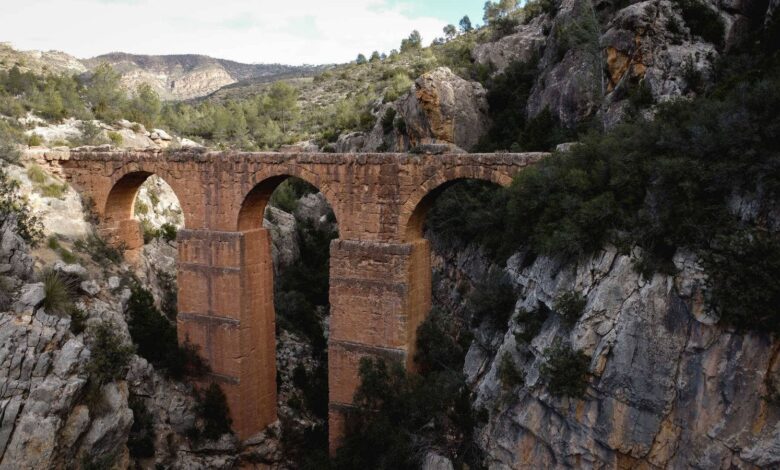
Among the most remarkable engineering features are the bridge over the Rambla de Alcotas ravine and the bridge spanning the Barranco del Gato gully. However, the aqueduct owes its name to its main highlight—a massive crevice in the rock known as Peña Cortada (“Cut Rock”). Beyond it lies a narrow gallery hewn directly into the mountain, open today for visitors to walk through. This section stands as vivid proof of the immense effort invested in its construction.
The bridge crossing the Cueva del Gato ravine is especially noteworthy. Its arches, lined up atop stepped supports, rise to a height of 33 meters and span 36 meters in length. The structure was built using the opus quadratum technique, typical of Roman monumental architecture, featuring perfectly fitted stone blocks. This blend of civil engineering and wild nature makes the site a must-visit for anyone interested in ancient hydraulic engineering.
Route for travelers
Today, the Peña Cortada Aqueduct is more than just an archaeological site—it’s part of several well-marked hiking trails. The most popular route, PR-CV 92, starts in the town of Calles and gives travelers a true sense of the structure’s scale. Visitors can walk through ancient tunnels, follow the channel where water once flowed, and explore galleries whose walls still bear the marks of the original builders’ tools.
The route is of moderate difficulty and is suitable for people with basic physical fitness, including families with children. However, some sections run along narrow paths with steep drop-offs, so caution is advised. Sturdy hiking shoes and a supply of water are essential, especially during the spring and summer months. Exploring the aqueduct offers not only a lesson in history but also unforgettable views of Mediterranean landscapes and deep canyons.
Cultural surroundings
This site is further enhanced by its proximity to vibrant municipalities such as Chelva, with its medieval layout and historic districts, or Calles, where 18th-century rural architecture has been preserved. Visiting these towns offers a deeper immersion into the region’s cultural context, adding to the experience of walking along the ancient aqueduct. Altogether, Peña Cortada stands out as one of the greatest archaeological treasures of the Valencian region and a must-see for anyone seeking history, scenic landscapes, and outdoor activities all in one place.
Incidentally, Spain’s Roman heritage is incredibly rich and goes far beyond aqueducts. Across the country, there are preserved theaters, amphitheaters, temples, roads, and bridges—all testaments to the profound influence of the Roman Empire on the Iberian Peninsula. Cities like Mérida (Extremadura), Tarragona (Catalonia), and Segovia (Castile and León) are true open-air museums. The designation of ‘Asset of Cultural Interest’ (Bien de Interés Cultural) is the highest level of heritage protection in Spain, granted to the most significant monuments of architecture and archaeology.