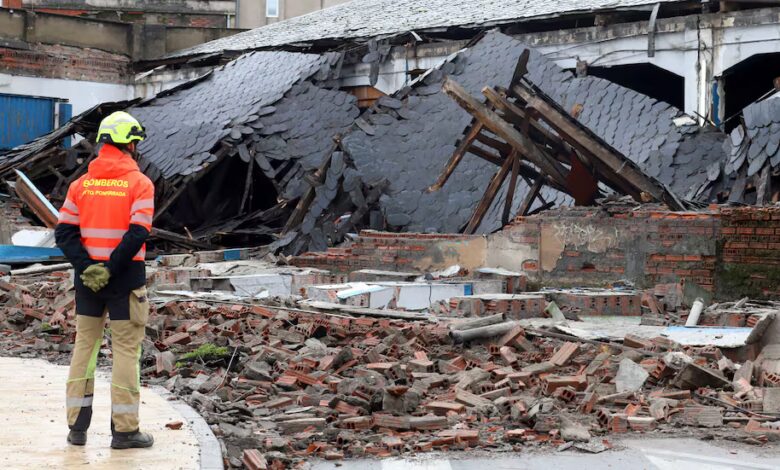
The powerful storm Joseph once again reminded the residents of Castile and León how vulnerable the region’s infrastructure is in the face of natural disasters. The impact of the severe weather is already being felt on the roads and near rivers: key transport routes are closed, and water levels in reservoirs are rising rapidly. For many locals, this is more than just an inconvenience—it’s a real threat to their safety and daily routine.
On Tuesday night, a sudden landslide occurred in the mountainous area of Palencia province, completely blocking traffic on one of the key roads leading to the town of Guardo. A truck driver became trapped when his vehicle was partially buried by earth and fallen trees. The rescue operation was swift, with no reported injuries, but the section of road remains closed until clearing work is complete. Drivers have to take detours, and local residents fear further landslides.
Roads under threat
Road problems were not limited to Palencia. In Zamora province, an accident occurred in the morning: a driver failed to notice a tree knocked down by the storm on the road and crashed into it at high speed. Fortunately, thanks to his seatbelt and an airbag, the man was unharmed. However, this incident once again raises the question of how prepared road services are for extreme weather and how promptly they remove obstacles from highways.
As a result of the incidents, traffic on several road sections has been slowed or completely halted. Drivers are forced to change their usual routes, and transport companies are incurring losses due to delays. Regional authorities urge everyone to exercise caution and, if possible, avoid traveling to the hardest-hit areas.
Rivers overflowing their banks
The situation near bodies of water is no less alarming. Due to heavy rainfall in recent days, several rivers in Castilla y León have reached critical levels. In Zamora province, the Tera River has been placed on orange alert: the water flow exceeds 200 cubic meters per second. In Rionegro del Puente, a yellow alert has been declared for the Negro River, while in the provinces of León and Salamanca, similar warnings are in effect for the Duerna and Huebra rivers.
Local residents are closely monitoring water levels, fearing flooding and shoreline destruction. In some towns, evacuation of belongings from riverside homes has already begun, while farmers are hastily reinforcing levees and temporary barriers. Authorities warn that if heavy rains continue, the situation could get out of control.
Consequences for the region
A series of storms that hit Spain in January has already led to a noticeable increase in emergencies in Castilla y León. Experts note that such weather events are becoming more frequent, while the region’s infrastructure is not always prepared for this level of strain. As a result, not only transport and agriculture are affected, but also the daily lives of thousands of people.
Regional authorities are forced to respond promptly to new challenges: additional patrols are organized on the roads, monitoring of rivers is intensified, and emergency services are working around the clock. However, many residents believe that preventive measures are taken too late and are demanding a review of the region’s disaster risk management approaches.
Response and Expectations
While experts continue to assess the damage and forecast how the situation may develop, the people of Castilla y León are bracing for new challenges. On social networks, discussion focuses not only on the aftermath of the storms, but also on the effectiveness of local authorities. Some users point out that such incidents are becoming routine and call for more substantial investment in strengthening the region’s infrastructure.
Meteorologists warn that precipitation will not subside in the coming days, which means the risk of new landslides, accidents, and flooding remains high. For many families, this means they must be prepared for emergencies and reconsider their usual routes. The question of how well the region is prepared for such challenges remains unanswered.