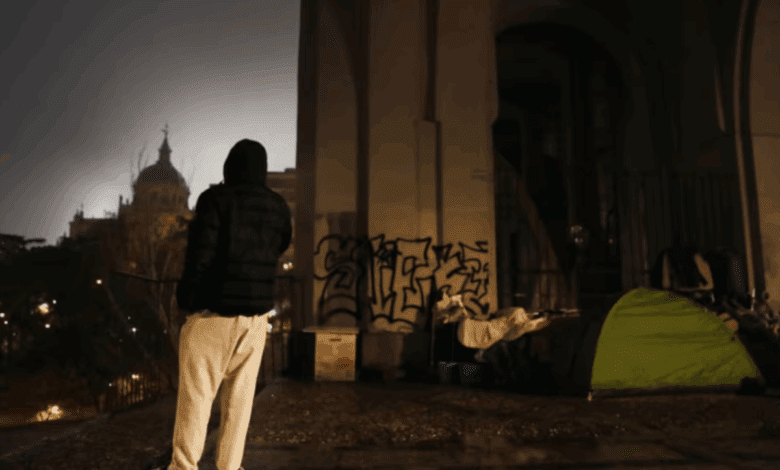
In recent months, Madrid residents have been experiencing changes that are hard to ignore. In familiar courtyards and under awnings that once offered shelter from the rain, entire settlements of cardboard boxes and tents now appear. These improvised dwellings not only transform neighborhoods but have also become a symbol of rising social anxiety that can’t be overlooked. For many Spaniards, this is more than just an inconvenience—it’s a troubling sign that homelessness is growing beyond usual limits and affecting more people.
The emergence of these encampments began with a single mattress and a few boxes, but the situation changed dramatically in a short time. Cardboard shelters quickly turned into complex structures reinforced with tarps and ropes. Now, these makeshift homes resemble a miniature city, with every corner occupied by someone who ended up on the street for various reasons. Neighbors note that the passageways under the awnings have become impassable and familiar routes must be changed.
Tents in parks
Parks, once favorite places for strolling with children and dogs, are now dotted with colorful tents. At first glance, they add a touch of brightness to the area, but behind this façade lies a harsh reality. Many residents admit they try to ignore the new settlements, but the smells and trash make that impossible. Dog owners are forced to find new routes to avoid unpleasant situations, as sanitary conditions in these areas leave much to be desired.
The sight of these tent camps evokes mixed feelings among passersby. Some feel fear, others compassion. But most prefer to discuss the problem only when it becomes too visible or interferes with their usual way of life. The gap in society is widening between those who find themselves on the street and those who can still afford a home. Words are becoming more cautious, and discussions increasingly detached.
Social distance
In recent years, attitudes toward the homeless have been changing. They are now referred to as ‘people without housing’ or ‘in a situation of homelessness,’ avoiding direct definitions. But behind these words lies real pain and alienation. Spaniards are increasingly aware that misfortune can affect anyone: just a few wrong decisions are enough to end up on the street. In makeshift cardboard settlements, people of various backgrounds live side by side—from those who lost their jobs or families to those struggling with addiction or mental health issues.
Life on the street makes every problem worse. Cold, loneliness, and constant stress take a toll on both health and the mind. For many, a neighborhood that once seemed cozy and safe becomes a trap they can’t escape. Residents watch this happen from the sidelines, but few realize how thin the line is between stability and vulnerability.
Personal stories
Recently, in one of Madrid’s parks, a woman could be seen who stood out due to her unusual appearance and behavior. Her clothes resembled a patchwork quilt, and her makeup was bright yet careless. At first, she simply seemed eccentric, but over time it became clear that a deep personal drama lay behind this image. Her dog often got into conflicts with other animals, and the woman herself started appearing barefoot more frequently, with a strong smell of alcohol.
Gradually, she disappeared from her neighbors’ sight. No one knows where she is now—perhaps she is hiding in one of the tents, or maybe she has left the neighborhood for good. For many, this story has served as a reminder of how quickly someone can end up on the margins of society, and how little we know about the fates of those living nearby.
The limits of compassion
The problem of homelessness in Madrid is becoming increasingly visible and acute. Authorities are trying to address it in various ways: sometimes relocating people from one area to another, sometimes simply removing them from view. But the root of the problem remains—social isolation and the indifference of others. For many city residents, this is not just a question of comfort, but a challenge to their usual ideas of justice and solidarity.
While some debate new terms and look for ways to distance themselves from the issue, others see a reflection of their own fears in what’s happening. The question of where the line lies between ‘us’ and ‘them’ is becoming more relevant than ever. And every day on the streets of Madrid, new evidence emerges that this boundary may be much closer than it seems.