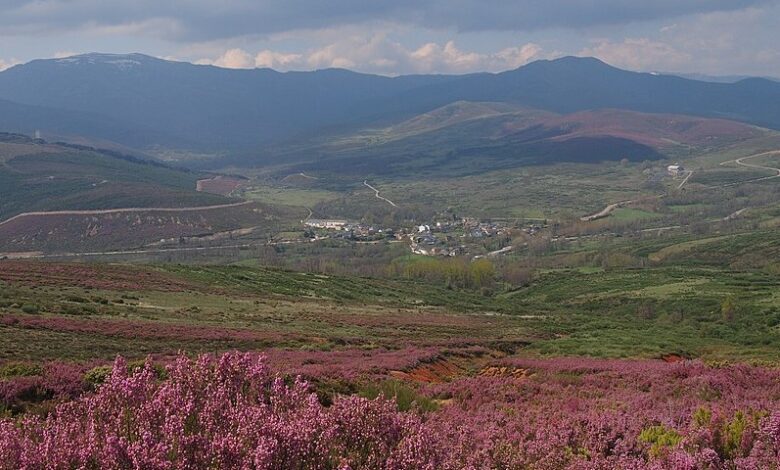
When we think of the largest cities, our imagination often conjures up densely populated metropolises with skyscrapers and bustling streets. However, in Spain, especially in its lesser-known regions, there are places that break these stereotypes. The province of León, located in the northwest of the country, hides true giants in its mountains and valleys—places whose size is measured not by population, but by sheer territory. One such municipality in terms of area surpasses even the provincial capital and the second-largest city combined.
A giant on the map
This is Truchas (Truchas), a municipality sprawling across the picturesque district of La Cabrera. Located in the southwest of the province, right on the border with Zamora and Ourense, it holds the record for the largest area. Its territory covers an impressive 373 square kilometers. To put this into perspective: the second-largest city in the province, Ponferrada, has an area of 283 km², while the provincial capital, León, occupies just 39 km². This means that Truchas alone is larger than these two major centers combined.
The paradox is that, despite its vast territory, very few people actually live here. The municipality is a conglomerate of thirteen scattered villages and hamlets. While Truchas is the official administrative center, Corporales is considered the main settlement, with only around 120 residents as of 2019. No other locality within the municipality surpasses one hundred inhabitants, making this area one of the most sparsely populated in the region.
Life far from the hustle and bustle
Choosing to live in Truchas means embracing absolute tranquility, a deep connection with nature, and immersion in authentic rural life. Here, time seems to flow differently. Life moves at a slow and measured pace, with daily routines closely tied to the surrounding landscape. The mountain climate sets its own rules: cold, snowy winters give way to mild and pleasant summers, and the scenery of La Cabrera becomes an inseparable part of daily existence.
The local economy has traditionally relied on agriculture and livestock farming. In recent years, however, rural tourism has been gaining popularity. Travelers weary of city life come here seeking peace, fresh air, and unique natural trails. Local residents form a close-knit community living across a network of small villages, linked by narrow roads and far removed from the noise and troubles of larger cities.
Provincial records
The province of León is also full of other geographical and demographic curiosities. For example, it is home to the settlement with the longest name in all of Spain—Colinas-del-Campo-de-Martin-Moro-Toledano. This charming village in the municipality of Igüeña, whose name is famous for its length, stands in stark contrast to the tranquility of the place itself, which is surrounded by forests and mountains.
Speaking of other large municipalities by area, after Truchas, Boca de Huérgano stands out, located in the Riaño mountains. Its territory covers 288 square kilometers in the heart of the León mountains, featuring picturesque valleys, reservoirs, and extensive pastures. However, if we shift the criteria from size to population, the picture changes dramatically. Here, the undisputed leader after the capital is Ponferrada, with around 63,000 residents, followed by San Andrés del Rabanedo, which is home to nearly 30,000 people.
By the way, the province of León has a rich history and cultural heritage. It was once the center of the medieval Kingdom of León, one of the key states on the Iberian Peninsula. Today, as part of the autonomous community of Castilla y León, it attracts tourists not only with its natural parks such as Picos de Europa, but also with its historical landmarks. The famous pilgrimage route Camino de Santiago passes through the province, and the capital, León, is renowned for its Gothic cathedral, considered one of the most beautiful in Spain.