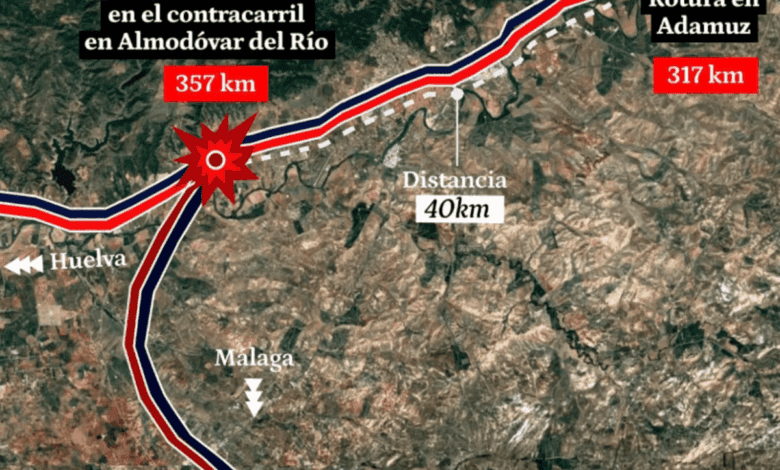
The derailment of the Iryo train in Adamuz (Córdoba province) has become a wake-up call for Spain’s entire railway system. The cause of the accident was a defective weld between two rails: one installed as far back as 1989, and the other installed just recently, in 2023. This incident has not only raised doubts about the quality of the work carried out, but has also sparked debate over the true scope of the modernization of the country’s first high-speed rail line between Madrid and Seville. For thousands of passengers and industry workers, the consequences could be far more serious than they appear at first glance.
At the center of attention is the metal rail joint, which experts say played a critical role in the incident. Iñaki Barrón, head of the Commission for Technical Investigation of Accidents (CIAF), openly wonders why such an important reform did not include the rails themselves and was limited to only partial upgrades. This question is now being debated not only among industry specialists, but also at the highest political levels.
Critical weld
Key sections of the track are now being prepared for laboratory analysis. Special focus is on the weld that joined the old and new rails. According to Barrón, such failures are not uncommon, but they do not always end in disaster. This time, the consequences proved fatal, and now specialists are working to determine whether the tragedy could have been prevented.
While experts examine the details, public distrust in the quality of recent infrastructure projects is on the rise. Many are questioning whether cost-cutting on materials and technology led to only a partial modernization. It has emerged that during the recent renovation of the Madrid-Seville line, not all rail sections were replaced—only specific elements were updated. This decision is now facing growing criticism.
Political implications
Concerns about railway safety have moved beyond industry experts. The standing committee of Congress is preparing to review an urgent report request from Transport Minister Óscar Puente. The opposition insists on an immediate account of the implementation progress of the so-called ’emergency action plan’ for the rail network, which was included in the mobility law at the end of 2025.
This law, at the opposition’s insistence, outlined additional obligations for the Ministry of Transport: to develop not only an emergency action plan but also protocols for incident analysis, as well as to restore the previous standards for punctuality and compensation for Renfe passengers that were changed in 2024. Now, after the accident in Adamuz, these requirements have taken on new urgency.
Questions about the reforms
Among experts and the public, there is a growing sense that the modernization of Spain’s railways may not have gone deep enough. Why weren’t all outdated tracks replaced during the upgrade of the first AVE line? Why were key infrastructure elements left unaddressed? These questions are becoming more pressing, especially in light of the recent accident.
Experts point out that such incidents could prompt a re-evaluation of the entire policy on railway construction and maintenance. With passenger traffic on high-speed lines steadily increasing, any compromises on safety are becoming unacceptable. Meanwhile, the investigation continues, and the public awaits answers to the most urgent questions.