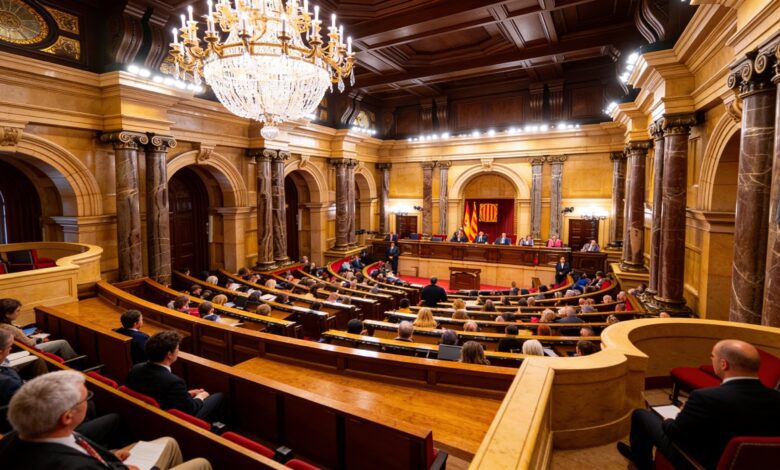
The decision made by the Tribunal Superior de Justicia de Catalunya (TSJC) was an unexpected turn for Catalan authorities and generated widespread reaction among local residents. The court ordered the Catalan Parliament to immediately and continuously display the Spanish flag on the building’s main flagpole, directly impacting issues of national symbols and relations between Barcelona and Madrid. Until now, the Spanish flag and the Catalan senyera appeared on the façade only during plenary sessions, which had sparked debate and repeated complaints from public organizations.
The court ruling partially upheld the lawsuit filed by Impulso Ciudadano, an organization that has actively opposed language immersion policies and participated in events surrounding the procés. As reported by El Pais, the judges found that the parliament violated the provisions of Ley 39/1981, which regulates the use of state flags, as the Spanish flag was not flown continuously despite the parliament’s status as a state institution. Now, parliament must decide whether to appeal the decision or comply with the court’s order in the near future.
Arguments of the parties
During the proceedings, Impulso Ciudadano submitted photographs of the parliament building showing that on regular days flags are absent and only appear on session days. The organization demanded either to have the Spanish flag displayed alongside the senyera on a permanent basis or to remove the external flagpole and place both flags on the roof. After reviewing the case materials, the judges concluded that the law requires the constant presence of the national symbol, disregarding arguments that the flag appears in the chamber during plenary sessions.
The second part of Impulso Ciudadano’s request—to make the Spanish flag constantly visible inside the building—was rejected. The court decided that having the flag in the chamber on plenary meeting days complies with the law. Notably, prior to Catalonia Day and in coordination with the Barcelona city council, a large senyera was installed in Parc de la Ciutadella, but this gesture did not influence the court’s stance on the national flag issue.
Reaction and consequences
The TSJC’s decision sparked strong debate among politicians and public figures. Impulso Ciudadano representatives have already announced they will monitor the enforcement of the decision and continue to advocate for legality and institutional neutrality. Meanwhile, the Parliament of Catalonia faces a choice: to adopt new rules or attempt to challenge the decision through proper channels.
As El Pais reports, the issue of flags in Catalonia has repeatedly sparked controversy, especially during periods of political tension. The question of symbols often goes beyond formalities and becomes part of a broader dialogue about the region’s status and its relationship with central authorities. The court’s decision could set a precedent for other government institutions in Spain’s autonomous communities.
Context and similar cases
In recent years, the placement of national symbols in public institutions across Spain has frequently led to legal disputes. For instance, similar controversies have arisen in municipalities in the Basque Country and Valencia, where local authorities sought to restrict the presence of the national flag on public buildings. In some cases, courts have also upheld the flag law, demanding compliance with national standards. These rulings often sparked further debate on balancing regional identity with the requirements of national legislation.