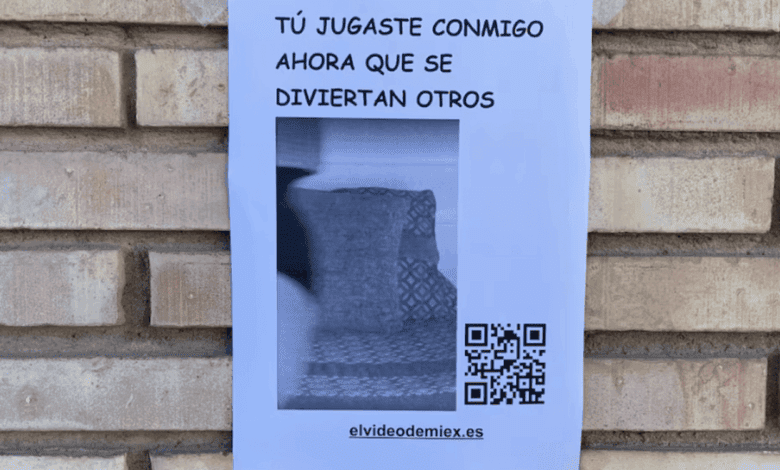
The morning in Zamora began with an unexpected sight: the city’s streets were covered with mysterious posters featuring a QR code and a provocative message. Passersby who scanned the code were redirected to a website that purportedly hosted an intimate video. In reality, instead of the video, they were met with a social message highlighting the issue of digital abuse, specifically the distribution of personal content without consent.
The organizers of the campaign, held in conjunction with the International Day for the Elimination of Violence against Women, aimed to draw attention to an issue that often remains in the shadows. They recreated a scenario in which a woman’s private video was made public without her knowledge. This approach proved not only shocking but also highly effective: in just one day, the website was visited by over 1,400 people, and many of the posters vanished from the streets within just a few hours.
Public Reaction: Alarm and Solidarity
Residents did not remain indifferent. Within hours of the posters appearing, dozens of locals contacted the police about possible rights violations and threats to privacy. People of all ages and genders expressed not only concern but also a willingness to act to prevent the spread of intimate materials without consent.
The response took even the organizers by surprise. They note that the mass removal of posters and the reports to law enforcement point to a growing intolerance of digital abuse. A new social awareness is emerging around a problem that until recently seemed largely invisible.
Statistics: The Scale of the Problem in Spain and Worldwide
Recent studies confirm that digital violence against women is not a rarity but a daily reality. According to international organizations, more than 70% of women have experienced online aggression. In EU countries, millions of women have faced online abuse since adolescence.
The statistics among minors are particularly alarming: three out of four teenagers have encountered sexualized pressure online. In Spain, most victims of non-consensual sharing of intimate materials are girls under 18, with nearly half not yet 13 years old.
Provocation for Change: Why the Experiment Worked
The idea for the campaign emerged after a tragic incident several years ago, when an employee at a major company took her own life due to a leaked private video. Since then, the problem has only worsened: among young people, sharing someone else’s intimate materials—often out of revenge—has become commonplace.
The organizers admit they expected a strong reaction. The provocative posters and people’s curiosity did their job: thousands became interested in the subject, and many started thinking about the consequences of their actions in the digital space. At the same time, the mass removal of posters and police reports showed that society is ready to defend personal boundaries and not tolerate violence online.
A New Wave of Awareness
The experiment in Zamora turned out to be more than just an event; it became a kind of test of the society’s maturity. The swift and decisive response from residents shows that attitudes toward digital violence are changing. People are increasingly seeing the distribution of intimate material without consent as a serious crime, not just a harmless prank.
The campaign demonstrated that even a single provocative gesture can spark widespread discussion and shift public perception of the issue. As the internet becomes an integral part of everyday life, protecting personal boundaries and respecting privacy are taking on new importance. Spanish society, it seems, is ready for change.