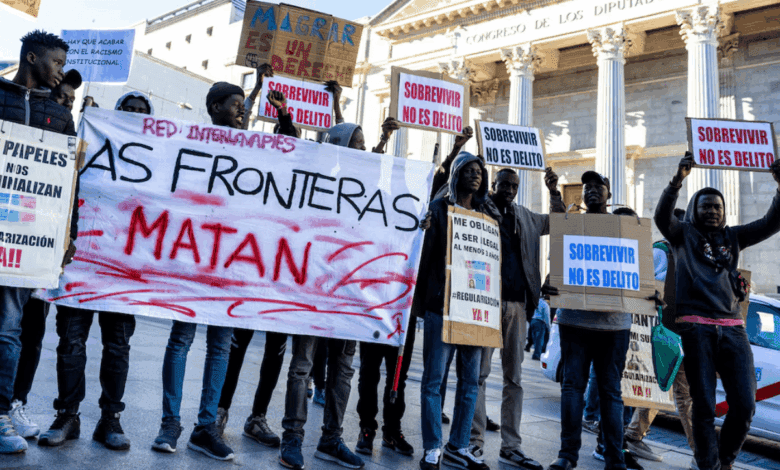
The question of who will be able to vote in the upcoming elections after the large-scale legalization of immigrants has become one of the most debated topics in Spanish society. The government’s decision to initiate an extraordinary legalization process sparked intense controversy: some see it as an attempt to shift the electoral balance, while others view it as a move toward social justice. Amidst political clashes, many people remain uncertain about how the rights of new residents and naturalized citizens will actually change.
The situation is complicated by the fact that voting rules differ significantly for various categories of foreigners and descendants of Spanish emigrants. Questions about who can participate in elections and when have become especially pressing on the eve of new electoral cycles. In 2026, Spain faces a unique combination of legal reforms and demographic changes that could shape the country’s political landscape.
Legalized residents
For those who obtained legal status as a result of the latest wave of legalization, the rules remain strict. Even after receiving a residence permit, such foreigners are not allowed to vote in national or regional elections. The only exception is municipal elections, and even then—only if certain conditions are met.
First, you need to have lived in Spain for at least five consecutive years. Second, your country of origin must have a reciprocity agreement on voting rights with Spain. In 2023, this list included, for example, Bolivia, Chile, Colombia, Ecuador, Peru, as well as the United Kingdom, Norway, and New Zealand, though the latter are subject to additional restrictions. Additionally, registration at your place of residence and inclusion in a special electoral register are required.
Thus, even after legalization, the path to the ballot box remains long and difficult for most migrants. Many will not be able to exercise their right to vote in the upcoming elections, despite changes in legislation.
New citizens
The situation is quite different for those who have obtained Spanish citizenship. After completing the naturalization process and if there are no court-imposed restrictions, such citizens can vote at all levels — from municipal to national elections. However, the path to a Spanish passport is rarely a quick one.
In most cases, you must reside in the country legally for at least ten years. For refugees, this period is reduced to five years, and for those from Latin American countries, Andorra, the Philippines, Guinea-Bissau, Portugal, and for Sephardic Jews — to two years. Only after obtaining citizenship and reaching adulthood does the opportunity to participate in elections at any level arise.
The next general elections in Spain are scheduled for 2027, and only those who complete the naturalization process before this date will be able to take part in voting. For many regularized migrants, this means their political influence will not be immediate.
Descendants of exiles
A special status is given to the descendants of Spanish emigrants and exiles who were able to obtain citizenship under the Law of Democratic Memory (Ley de Memoria Democrática). This initiative has allowed millions of people whose ancestors were forced to leave Spain to reconnect with their historical homeland.
After receiving citizenship and registering in the special census (CERA), these citizens can vote in national elections even if they live outside Spain. However, they cannot participate in municipal elections as they are not registered in a specific Spanish city or region. By the end of 2025, more than a million applications for citizenship under this program had been submitted, with about half already approved.
The application period ended in autumn 2025, and attention now turns to how the new citizens will impact the country’s political landscape. Their participation in elections could shift the balance of power, especially since many of them have their own perspective on Spanish politics.
Political debates
The question of how new citizens may influence election outcomes has sparked heated debate. Representatives from some parties argue that mass legalization and naturalization are attempts to artificially increase the number of loyal voters. Such accusations have come in particular from VOX and segments of the Partido Popular.
Experts, however, note that the process of obtaining citizenship and the right to vote remains complex and lengthy. According to Professor Carles Pemies, most Latin Americans in Spain traditionally support left-wing parties, except for those from Venezuela and Cuba. Nevertheless, neither new laws nor expedited procedures alter the fundamental principles of naturalization and participation in elections.
The public debate persists: some fear that new citizens will shift the political landscape, while others believe their impact is exaggerated. In any case, the issue of voting rights for regularized migrants and the descendants of exiles remains among the most contentious in modern Spain.