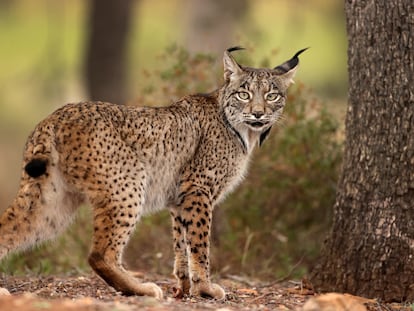
In early October, in the province of Jaén, an event took place that astonished even seasoned naturalists. Amateur photographer Ángel Hidalgo had a chance encounter in the forest with an animal that immediately stood out due to its unusual appearance. Before him stood an Iberian lynx with snow-white fur and striking eyes—a sight that seems almost unbelievable to those used to seeing these predators with reddish-brown coats covered in dark spots.
The hunt for this mysterious creature lasted several months for the photographer. At first, he spotted the unusual lynx on one of the trail cameras set up to observe wildlife. After that, began the long search: days and weeks spent waiting for a second chance to see the ‘ghost of the Mediterranean forest’. Finally, after a rainy night, at dawn, luck smiled—on the edge of the woods, a white silhouette appeared, as if glowing against the still-damp grass.
It turned out that this animal is a female named Satureja, born in 2021. She is well known to specialists working on the restoration of the Iberian lynx population in Andalusia. Interestingly, Satureja was born with a normal coat color, but over time her fur turned white, although the distinct black spots typical for the species remained. Despite this, Satureja’s health and behavior have not changed: she continues to hunt successfully and has already raised several litters.
The mystery of the white fur: neither albinism nor leucism
Scientists emphasize that the unusual coloration of the Satureja is not linked to albinism or leucism. With albinism, pigment is missing not only in the fur but also in the eyes, which leads to serious health issues. Leucism also causes a loss of color, but the eyes remain normal. In the case of Satureja, only the pigments responsible for red and brown tones were affected, while the black spots remained. This suggests that the mechanism behind the lynx’s color change is different and still remains a mystery.
So far, experts cannot say for certain what caused such a rare mutation. There is a theory that some environmental factor may have influenced the change in coloration. Interestingly, a similar case was previously recorded in Andalusia: another female lynx, born with a typical coat color, suddenly turned white, and then returned to her normal coloring. Both females come from the same region, and it’s possible they are related. This could point to a genetic predisposition or an increased sensitivity to environmental influences.
Iberian lynx population continues to grow
Despite the mysterious cases of color change, Spain’s Iberian lynx recovery program is yielding results. According to 2024 data, the population has reached 2,401 individuals, including 1,557 adults and subadults, and 844 cubs. The number of breeding females has risen to 470, bringing the population closer to the target of 750 individuals needed for the species’ long-term survival.
Experts note that such close attention to rare cases, like with Satureja, has become possible thanks to ongoing monitoring. However, it is possible that similar phenomena may occur in other species but go unnoticed. The unique story of the white lynx once again highlights how little we know about nature and how important it is to continue studying it.